Vancouver Startup Lunch Perks Without the Enterprise Budget
Vancouver startups want Google-level lunch perks but have seed-stage budgets. Here's how to build a team meal program that boosts culture and retention without the six-figure catering bill.
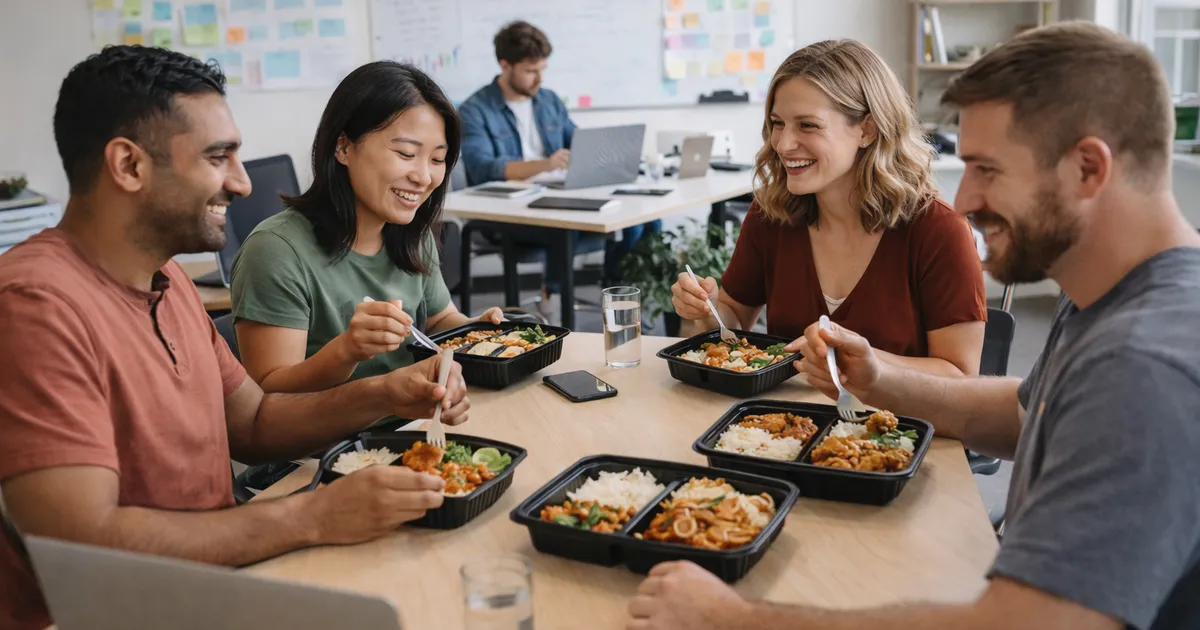
Every startup founder in Vancouver has visited a FAANG office at some point and seen the free lunch setup. The made-to-order stations, the sushi bar, the wall of snacks. It's impressive. It's also backed by a per-employee catering budget that exceeds most startups' entire monthly operating expenses.
Then they go back to their Gastown walkup or their Railtown warehouse office and look at their team of 12 eating Subway at their desks, and they think: "We should have something like that." Followed immediately by: "We absolutely cannot afford anything like that."
Here's what I've learned working with Vancouver startups: you don't need Google's budget to build a lunch program that genuinely matters to your team. You need $10–$15 per person, a system that doesn't waste your operations lead's time, and the clarity to understand what team meals actually do — which isn't about the food. It's about building a culture where people want to show up.
The Startup Lunch Paradox
Startups have the strongest case for team meals and the weakest budget to fund them. Here's why the case is strong:
1. Early-stage culture is fragile.
When you're 10–20 people, every interpersonal dynamic matters. A shared lunch three times a week creates a rhythm — a daily convergence point where the engineering team, the sales team, and the founders actually talk to each other about something other than sprint tickets and pipeline. I've watched startups where the founders ate separately from the team, and the cultural gap widened silently until one day half the engineering team gave two weeks' notice. Shared meals don't prevent that by themselves, but they create the conditions where problems surface before they become departures.
2. Startups compete for talent against companies that offer lunch.
A developer choosing between your 15-person startup and a mid-size tech company in Mount Pleasant is weighing everything: equity, growth opportunity, culture fit — and, yes, perks. "We have team lunch" isn't going to tip the decision on its own, but "we have no benefits, no lunch, and you'll eat ramen at your desk" signals an environment that doesn't invest in its people. In Vancouver's tech market, where competition for talent is real even during slower periods, visible quality-of-life investments matter disproportionately.
3. Startup employees work longer hours and skip meals more often.
This is the practical argument. Your engineers are heads-down until 1:30 PM without realizing they haven't eaten. Your sales team is on back-to-back calls from 10 to 2. Your founder is in funding meetings all morning and comes back to the office at 3 PM running on coffee. When lunch is delivered and sitting in the kitchen, people eat. When it's not, they don't. The productivity difference between a fed team and a hungry team at 3 PM is not subtle.
The budget constraint:
Seed-stage: $0 for perks. Every dollar goes to runway. Series A: Maybe $2,000–$5,000/month for culture initiatives. Lunch competes with team outings, off-sites, and equipment. Series B: $5,000–$15,000/month for employee experience. Lunch becomes feasible as a regular program. Growth stage: Budget available, but now you have 50+ people and the logistics are different.
Most Vancouver startups I work with are in the Series A to Series B range — 15 to 40 people, with enough budget to do something but not enough to do everything. That's the exact range where our $10–$15 per person pricing makes a team meal program possible without requiring executive sign-off on every meal.
What $10–$15 Per Person Buys at a Startup
Let me be specific, because startup founders are allergic to vague pricing.
At $10/person (the seed-stage starter):
- Chinese-cuisine-focused rice box with protein (char siu, braised chicken, curry pork)
- One vegetarian option daily
- Functional sealed packaging
- Delivered to your office kitchen or common area
- Rotating weekly menu (4–5 different meals across the week)
At $12/person (the Series A sweet spot):
- Broader variety — 3 options per delivery day
- Larger portions
- Soup or side dish additions on some days
- Better suited for teams that eat at standing desks or in meeting rooms
At $15/person (the Series B experience):
- Multiple cuisine options per day
- Presentation-suitable packaging (good enough for investor meetings)
- Access to our broader 120+ restaurant network beyond the Chinese-cuisine core
- Board meeting or demo day quality available on request
Monthly cost for a 20-person startup, 3 days/week:
| Price Tier | Per Meal | Weekly (20 people × 3 days) | Monthly | Annual |
|---|---|---|---|---|
| $10 | $10 | $600 | $2,400 | $30,000 |
| $12 | $12 | $720 | $2,880 | $36,000 |
| $15 | $15 | $900 | $3,600 | $45,000 |
For most startups in the 15–25 person range, $2,400–$3,600 per month gets you a legitimate team lunch program three days per week. That's the cost of one additional software subscription or half a team offsite. And unlike an offsite that happens once a quarter, team lunch happens every week — the cultural compound interest is continuous.
Why Chinese Cuisine Is the Startup Budget Hack Nobody Talks About
I'll explain something that most catering conversations dance around: the reason we can offer quality meals at $10–$12 per person is our Chinese-cuisine-focused restaurant network.
This isn't a limitation — it's an advantage. Here's why:
1. Ingredient economics. Chinese cuisine uses rice as a base, which is inexpensive relative to bread or pasta at scale. Proteins like char siu, braised chicken, and tofu are prepared in large batches that produce consistent quality at lower per-serving cost than individually grilled or seared Western preparations.
2. Cooking methods optimize for volume. Wok cooking and braising produce meals that maintain quality across large batch sizes. A braised pork belly over rice tastes the same whether you're making 10 or 50 portions. A delicate pan-seared salmon fillet? The 40th one isn't the same as the 5th.
3. Temperature resilience. Rice-and-protein dishes hold serving temperature longer and taste good across a wider temperature range than most Western meals. A teriyaki chicken rice box that's been sitting for 30 minutes is still a good meal. A gourmet burger that's been sitting for 30 minutes is a sad meal.
4. Cultural fit for Vancouver startups. Metro Vancouver's tech workforce is among the most culturally diverse in North America. Chinese, South Asian, Filipino, and Korean employees are well-represented. Rice-based meals aren't foreign food — they're comfort food for a significant portion of your team. And for team members who grew up on Western cuisine, well-prepared Chinese food at lunch is a genuinely welcome variety from the sandwich-and-salad default.
I should be transparent about what this means practically:
- Our $10–$12 tier is heavily weighted toward Chinese cuisine. If your team specifically wants Mediterranean, Japanese, or Mexican food daily, we can accommodate that at the $15 tier through our broader restaurant network, but it costs more.
- We handle regular dietary accommodations: vegetarian options daily, halal through certified partners, gluten-free selections. We don't guarantee nut-free environments — our kitchen partners use nuts, and while we can select naturally nut-free dishes, we can't certify the production environment.
- The food is genuinely good. I'll push back against any assumption that "affordable" means "institutional." Our restaurant partners cook for paying customers all day — the startup meals are the same food coming out of the same kitchens.
The Startup Meal Program Playbook
Here's how I recommend startups build their program, based on what I've seen work across dozens of Vancouver tech companies:
Phase 1: The "Culture Anchor" Start (Months 1–2)
Pick two days per week. Make them the same days every week. Ideally:
- One aligns with an all-hands or standup meeting
- One is a mid-week energy boost (Wednesday is the most popular choice)
Why two days, not five?
- Budget conservation (test at 40% of full cost before committing)
- Scarcity creates value (people look forward to meal days more than they would to an everyday program)
- Easy to expand later (moving from 2 to 3 days is a positive signal; cutting from 5 to 3 feels like a takeaway)
Setup:
- Designate one person (operations lead, office manager, or a willing volunteer) as the coordinator
- Their time commitment: 5 minutes per meal day (confirm headcount by 9 AM)
- Select a standing menu rotation — we recommend starting with 2 options per day (one meat, one vegetarian)
- Budget: $200–$300 per meal day for a 15–20 person team
Phase 2: The Expansion (Months 3–4)
If Phase 1 goes well — and in my experience, it always does because nobody dislikes free lunch — expand to three days per week. This is the sweet spot for most startups:
- Enough frequency to feel like a real benefit
- Not so frequent that it becomes invisible (people stop appreciating what's always there)
- Cost: $600–$900 per week, or $2,400–$3,600 per month
At this point, you might add a third menu option per day or start rotating across different restaurant partners for variety.
Phase 3: The Mature Program (Month 5+)
The program runs automatically. The coordinator confirms headcount daily. Meals arrive. People eat together. New hires hear "we have team lunch three days a week" during their first interview and it registers as part of the company culture.
Optional enhancements at this stage:
- "Celebration upgrades": When the team closes a big deal or ships a major release, step up to the $15 tier for that day. Everyone notices the upgrade, and it becomes a tangible marker of achievement.
- Investor meeting catering: Use the same platform for board meeting or demo day meals at $15/person with presentation packaging. One vendor, one invoice, seamless.
- All-hands meal days: Monthly or quarterly all-hands with everyone in the office? That's a natural meal day with full-team attendance.
What Startup Founders Get Wrong About Meal Programs
I've worked with enough startups to see the same mistakes repeat. Here are the three biggest:
Mistake 1: Going too big too fast.
A founder gets excited, commits to daily lunch for 25 people at $15 per head, and then has to cut the program two months later when the finance lead points out it's $7,500/month. The team feels the program was "taken away," which is worse than never having had it. Start with 2 days at $10–$12/person. You can always expand. You can't easily contract without damaging morale.
Mistake 2: Treating it as a food decision instead of a culture decision.
The founder who spends three weeks evaluating restaurant options, testing menus, and agonizing over whether to include gluten-free wraps is solving the wrong problem. The value of a startup meal program is 80% cultural (people eating together, feeling valued, building connection) and 20% culinary (the food tastes good). Pick a reliable vendor, set a rotation, and stop optimizing. The best meal program is the one that runs automatically while you focus on building the company.
Mistake 3: Not funding it from the right budget line.
Meal programs shouldn't come from the "office supplies" budget or the founder's personal credit card. They belong in the employee experience or talent retention budget — the same pool that funds team outings, professional development, and workspace improvements. This framing matters for two reasons: it makes the expense defensible to investors ("we invest in employee retention"), and it ensures the program survives budget reviews because it's categorized as strategic, not discretionary.
How It Compares to Other Startup Perks
Founders evaluating meal programs often compare them against other culture investments. Here's how the math shakes out:
| Perk | Annual Cost (20 people) | Frequency | Visibility | Retention Impact |
|---|---|---|---|---|
| Team lunch (3x/week, $12/person) | $36,000 | 150 days/year | Daily | High — continuous, tangible |
| Quarterly team off-site | $15,000–$25,000 | 4 days/year | Quarterly | Moderate — memorable but infrequent |
| Annual company retreat | $20,000–$40,000 | 2–3 days/year | Annual | Low-moderate — too infrequent for sustained impact |
| Gym membership subsidy | $12,000–$18,000 | Daily (in theory) | Individual | Low — used by 30–40% of employees |
| Professional development budget | $20,000–$40,000 | Varies | Individual | Moderate — valued but not communal |
| Snack wall / coffee budget | $6,000–$10,000 | Daily | Background | Low — expected, not appreciated |
Team lunch wins on the frequency × visibility × communal impact matrix. It happens three times a week, everyone experiences it simultaneously, and it creates shared moments that other perks (which are individual or infrequent) simply don't.
The snack wall comparison is instructive. Most startups with any culture budget already spend $500–$800/month on snacks and coffee. That money disappears into the background — nobody thanks you for the granola bars. Redirecting $500 of that budget toward structured meal days and adding $1,500–$2,500 creates a program with dramatically higher perceived value.
Summary: Vancouver startups in the 15–40 person range can build meaningful meal programs at $2,400–$3,600/month (3 days/week). Chinese-cuisine-focused menus at $10–$12/person make this affordable without sacrificing quality. Start with 2 days, expand to 3, and never go to 5 — scarcity creates appreciation, and contraction kills morale.
Last reviewed: March 2026. Data current as of this date.
Introduction
Vancouver's tech startup ecosystem competes with established companies for talent, yet most early-stage companies can't match the comprehensive benefits packages — including daily catered meals — that larger competitors offer, according to BC tech workforce research.[1] The result: startups default to no meal program at all, creating a daily quality-of-life gap that compounds into a cultural deficit over months.
After building meal programs for startups across Gastown, Mount Pleasant, Railtown, and the emerging tech corridors in East Vancouver, I've learned that the companies who solve the lunch problem early build stronger teams. Not because the food is magic — because the act of eating together, reliably and regularly, creates the tissue of shared experience that holds early-stage teams together through the inevitable chaos of startup life.
My Great Pumpkin serves startups as part of our B2B platform connecting 120+ Vancouver restaurants with corporate clients. Our Chinese-cuisine-focused restaurant partners are the reason we can offer quality meals at $10–$15 per person — a price point that makes team lunch feasible for companies watching every dollar of their runway. But I want to be upfront: we're not trying to replicate the Google cafeteria. We're trying to put hot, filling, reliably good food in front of your team three days a week so they eat together instead of eating alone at their desks. That's the goal. It's simpler than it sounds and harder than it looks.
What follows is a practical guide to building a startup meal program in Vancouver — the budget math, the cultural mechanics, and the operational details that separate programs that last from programs that get cut after two months.
Ready to simplify office meals?
Join 100+ Vancouver offices enjoying hassle-free lunch delivery. Free tasting, no contract.
Request a Demo →Quick Answer: How Can Startups Afford Team Lunch?
At $10–$12 per person for Chinese-cuisine-focused meals delivered 2–3 days per week, a 20-person Vancouver startup can run a meaningful meal program for $2,400–$3,600/month — competitive with a single quarterly team off-site but delivering 150 days of team-building impact annually, consistent with BC Tech Association guidance on competitive employee experience.[1] At My Great Pumpkin, we deliver to startup offices across downtown, Gastown, Mount Pleasant, and East Vancouver with flexible headcount and consolidated monthly billing.
The honest answer: startups afford lunch by starting small and pricing accurately. Most founders overestimate the cost because they're thinking about the $20–$30 per head catering they've seen at corporate events. At $10 per person, a 20-person team eating lunch together on Tuesday and Thursday costs $400/week — $1,600/month. That's less than what most startups spend on Slack, Notion, and AWS combined.
The key is our Chinese-cuisine restaurant network. A char siu rice box with vegetables from our Burnaby partners is a complete, satisfying meal at $10 — not because we're cutting corners, but because Chinese cuisine's ingredient and cooking economics naturally produce filling meals at lower cost than Western catering equivalents. The same quality of protein, the same cooking skill, just a different culinary tradition with different cost structures.
What we provide: rotating menus, individual packaging, daily vegetarian options, halal accommodations, delivery to your office, and one monthly invoice. What we don't provide: nut-free guarantees, daily sushi bars, or anything that pretends to be Google. What we do provide is a reliable, affordable system that gives your team three reasons per week to eat together — and that's enough to build the culture you're trying to create.
Why Team Lunch Matters More at Startups Than Anywhere Else
The Culture Multiplier Effect
In a 15-person startup, every shared experience has outsized cultural impact compared to a 500-person enterprise — a team lunch reaches 100% of your company, creating universal touchpoints that scale-stage companies can't replicate.[2]
I've delivered to startups that had strong product and weak culture, and the difference always showed up in the same way: people ate alone. Engineers at their desks. Sales in the meeting room. Founders somewhere else entirely. The team was physically co-located but culturally atomized — everyone working in parallel without the connective tissue that turns a group of employees into a team.
Shared meals solve this at the most basic biological level. When people eat together, they talk. When they talk regularly — not in standups where the agenda is work, but over food where the agenda is whatever comes up — they learn things about each other that build trust. The backend engineer mentions he's been struggling with a dependency issue, and the frontend developer says "oh, I dealt with something similar at my last company." The sales lead mentions a prospect's unusual objection, and the founder shares context about the competitive landscape that reframes the entire approach. These aren't scheduled knowledge-transfer sessions. They're accidents of proximity, and they happen reliably when people eat in the same room at the same time.
At a 500-person company, a catered lunch is a perk. At a 15-person startup, it's infrastructure.
The Retention Signal
Startup employees interpret visible investment in daily experience — like team meals — as a proxy for how leadership values people, making modest investments disproportionately impactful for retention.
Here's what I hear from startup employees during onboarding conversations: "It's not about the food. It's that they thought about it." The act of providing team meals signals something beyond nutrition:
- "This company has its act together." A startup that runs a smooth meal program demonstrates operational capability. If they can handle lunch logistics, they can probably handle product launches and customer onboarding too. It's a small competence signal that compounds.
- "They care about us beyond our output." Seed-stage startups are famous for extracting maximum work from every employee. A meal program says: "We know you work hard, and we're investing in you being fed and connected." That message resonates with people considering whether this is a place they want to be long-term.
- "The culture here is real." Anyone can put "great culture" on a job posting. A team that eats together three days a week and actually talks and laughs during meals — that's culture you can observe during an interview lunch.
I've seen startups use team lunch as an explicit part of their interview process. A candidate comes in, eats with the team, observes the dynamic. That meal tells the candidate more about the actual culture than any careers page or Glassdoor review.
The Productivity Argument
Startup employees who eat a proper lunch show measurably better afternoon performance, particularly in cognitively demanding roles like software development, design, and strategic sales.
The afternoon crash is the productivity killer that startups don't track but should. Between 2 and 4 PM, a developer who ate a proper lunch at noon maintains focus. A developer who had a coffee and a granola bar at 11 AM is fighting their biology to stay productive.
When lunch is delivered to the office:
- The average lunch break drops from 45 minutes (leaving to find food) to 20 minutes (walk to kitchen, eat, return)
- Eating happens at a consistent time rather than being skipped or deferred
- The team reconverges at the same time, creating a natural transition between morning and afternoon work blocks
- Afternoon meetings start with people who are fed and alert, not hungry and distracted
For a 20-person startup with an average blended cost of $50/hour, recovering 25 minutes of productive time per person per meal day adds up:
- 3 meal days/week × 25 minutes × 20 people = 1,500 minutes = 25 hours/week
- 25 hours × $50/hour = $1,250/week in recovered productivity
- Annual recovered productivity: ~$62,500
I'm not claiming this number is precise — it's an estimate, and actual productivity gains depend on role, work style, and individual habits. But the directional point is clear: the productivity recovery from structured lunch substantially offsets the program cost, and that's before counting the cultural and retention benefits.
Summary: At 15 people, team lunch reaches 100% of the company and creates daily culture-building touchpoints that 500-person companies can't replicate. The retention signal ("they thought about us"), the productivity recovery (~$62,500/year for 20 people), and the culture multiplier make meal programs among the highest-ROI startup investments available.
Practical Budget Models for Every Stage
Seed Stage: The Survival Kit ($0–$500/month)
At this stage, every dollar is runway. I won't pretend a $2,400/month meal program makes sense when you have 8 months of cash left. But here's what I've seen work:
"Friday Fuel" — 1 day/week, founder-funded
- 10–12 people × $10/person = $100–$120/week
- Monthly cost: $400–$480
- Founder often pays personally as a culture investment
- Creates one guaranteed weekly team moment
This is the minimum viable meal program. It costs less than the team's monthly coffee budget, and it establishes the habit of eating together before you have the budget to do it seriously.
At this scale, honestly, you might not need us. A founder ordering 12 rice boxes from a nearby Chinese restaurant once a week is fine. Where our platform adds value is when you cross 15 people and the logistics of direct ordering start consuming someone's time.
Series A: The Culture Builder ($1,500–$3,600/month)
This is where most of our startup clients land. You've raised funding, hired to 15–25 people, and the office has become the center of the company's identity. Team meals become a real program:
| Model | Days/Week | Per Person | Team Size | Monthly Cost |
|---|---|---|---|---|
| Conservative | 2 | $10 | 15 | $1,200 |
| Standard | 3 | $10 | 20 | $2,400 |
| Generous | 3 | $12 | 25 | $3,600 |
The $2,400/month standard model (20 people, 3 days, $10/person) is what I recommend to most Series A startups. It's sustainable, meaningful, and won't trigger investor questions about burn rate. For context, that's less than what most startups spend on team Zoom licenses, and it delivers more daily value.
Series B+: The Professional Program ($3,600–$7,500/month)
With 30–50 people and a proper HR/operations function, the meal program becomes a structured employee benefit:
| Model | Days/Week | Per Person | Team Size | Monthly Cost |
|---|---|---|---|---|
| Standard | 3 | $12 | 35 | $5,040 |
| Full | 5 | $10 | 30 | $6,000 |
| Premium | 3 | $15 | 40 | $7,200 |
At this stage, multi-tier pricing makes sense: $10–$12 for regular team meals, $15 for investor meetings and board days. Our platform handles both tiers through the same account, so the operations lead isn't managing two separate vendors.
What changes at this scale:
- Dietary diversity increases (more people = more dietary requirements). We handle vegetarian, halal, and gluten-free as standard. Complex individual programs are still beyond our scope.
- Menu variety matters more (40 people get bored of a 4-item rotation faster than 15). We can rotate across 10+ restaurant partners weekly at this volume.
- Hybrid work patterns create headcount variability. Our daily confirmation system handles this — the coordinator confirms the in-office count by 9 AM and that's what we deliver.
Summary: Seed stage: $400–$480/month for Friday team lunch. Series A: $2,400/month for 3-day programs (the sweet spot). Series B+: $5,000–$7,200/month for professional programs with multi-tier pricing. Each stage has a right-sized model that matches the company's budget and culture-building needs.
Conclusion
After building meal programs for startups across Vancouver's tech corridors — from Gastown co-working graduates to Mount Pleasant scale-ups to East Van's emerging office clusters — the pattern is consistent: the startups that implement team meals early build stronger, more cohesive cultures than those who treat lunch as an afterthought. The investment is modest. The impact is daily. And the compound effect of 150 shared meals per year far exceeds any quarterly off-site or annual retreat in sustained team-building value.
My Great Pumpkin makes this accessible at $10–$15 per person through our Chinese-cuisine-focused restaurant network — the same quality food that these restaurants serve paying customers, at price points that respect startup economics. Our platform handles menu rotation, delivery logistics, dietary accommodations, and consolidated monthly billing so your operations lead spends 5 minutes per day on lunch instead of an hour.
I'll be honest about what we are and aren't. We're not trying to build you a Google cafeteria. We're building a system where your team eats together three days a week, the food is consistently good, and the operational burden is close to zero. For a startup where culture is your competitive advantage and every dollar needs to justify itself — that's the right tool for the job.
The founders I admire most aren't the ones who provide the flashiest perks. They're the ones who create environments where talented people want to stay and do their best work. A reliable team lunch won't make up for bad equity, toxic leadership, or a product nobody wants. But in the large middle ground where most startups live — where the product has potential, the team is talented, and the difference between retention and departure is whether people feel genuinely cared for — lunch matters more than you'd think.
Start Your Startup Lunch Program
Explore startup meal plans for Metro Vancouver teams: https://www.mygreatpumpkin.com/demo
Summary: Startups that implement $2,400–$3,600/month meal programs early build measurably stronger cultures. At $10–$15/person with Chinese-cuisine-focused menus, the investment is modest relative to other startup perks but delivers 150 days of communal team-building impact annually — compounding returns that no quarterly off-site can match.
Looking for Vancouver's Asian-fusion meal partner?
The Storm Cafe delivers fresh bento boxes, rice bowls, and catering platters across Metro Vancouver — from Richmond to North Van. Retail orders, family meals, and corporate lunches all in one place.
References
[1] BC Tech Association (WeAreBCTech), "BC Technology Industry Workforce Report," 2026. Data on Vancouver tech talent competition, compensation benchmarking, and employee experience best practices. https://wearebctech.com/
[2] Startup Genome, "Global Startup Ecosystem Report — Vancouver Metro," 2026. Vancouver startup ecosystem analysis including team-building, culture investment, and early-stage company operational benchmarks. https://startupgenome.com/
Frequently Asked Questions
We're only 10 people — is it even worth setting up a meal program?
At 10 people, you're right on the edge. Our platform adds clear value at 15+, where the coordination overhead of ordering for the group starts consuming real time. At 10 people, you might be better off having someone order directly from a nearby restaurant — it's simpler and there's less logistics to justify a platform. That said, if you're growing to 15+ in the next few months, setting up the program now means it's already running when the team scales. The cost at 10 people on 2 days/week is $200/week at $10/person — that's very manageable as a culture investment even at seed stage.
How do we handle the hybrid work situation where different people are in the office on different days?
This is the norm for Vancouver startups now, and our system is built for it. Your coordinator confirms the actual in-office headcount by 9 AM each day. If 12 people are in on Tuesday and 18 on Thursday, we deliver 12 and 18 respectively. You only pay for meals ordered, not for your full roster. Most startups designate 2–3 "anchor days" where the team is expected to be in the office — those are natural meal program days. The meal itself becomes an incentive for in-office attendance, which helps solve the hybrid coordination problem from another angle.
Can we use the same platform for investor meetings and demo days at a higher tier?
Yes, and this is actually one of the most practical use cases beyond daily team meals. When you have a board meeting or a demo day, you can step up to the $15 tier through the same account — better packaging, broader menu selection, presentation-grade quality. One vendor, one relationship, one invoice. The alternative is scrambling to find a caterer for your investor lunch separately from your daily team meals, which means managing two vendor relationships and two billing streams. We handle both through your existing account.
What if we need to pause the program during a slow period or after a layoff?
We understand that startup life isn't linear. You can pause or reduce your program with notice to your account manager — no penalties, no awkward contract cancellation. If you go from 3 days/week to 1 day/week during a runway conservation period, we adjust without friction. The worst thing you can do is commit to a rigid program you might need to cancel entirely — it's much better to start modest and scale up than to start ambitious and scale down. We'd rather have you at 2 days/week sustainably than 5 days/week for two months followed by nothing.
How does your pricing compare to everyone just using UberEats individually?
At $10–$12 per meal through our platform versus $15–$20 per individual UberEats order (after delivery fees and platform markup of 25–30%), you're saving $5–$8 per person per meal. For a 20-person team eating 3 days/week, that's $300–$480/week in savings compared to individual app ordering — or $15,000–$24,000 annually. And that's just the price difference. The time savings are equally significant: no one is spending 15 minutes deciding what to order, no one is tracking individual receipts, and there aren't 20 separate deliveries arriving over a 45-minute window cluttering your front desk.
Related Articles
Staff Meal Programs for Veterinary Clinics in Vancouver
Keep your vet clinic team fed between appointments. Mess-free meals delivered to your Vancouver clin
Working Lunch Catering for Architecture Firms in Vancouver
Working lunches for Vancouver architecture firms. Feed your studio without disrupting charrettes or
Client Meeting Catering for Recruiting Agencies
Impress clients at your recruiting agency with catered meetings. Vancouver delivery, same-day orderi
Ready to streamline your office meals?
Join 100+ Vancouver offices enjoying hassle-free lunch delivery.
Request a Demo