How Vancouver Companies Handle Daily Office Lunches (2026)
Discover how Vancouver companies manage daily office lunches in 2026. From catering platforms to meal programs, explore solutions that boost productivity and employee satisfaction.
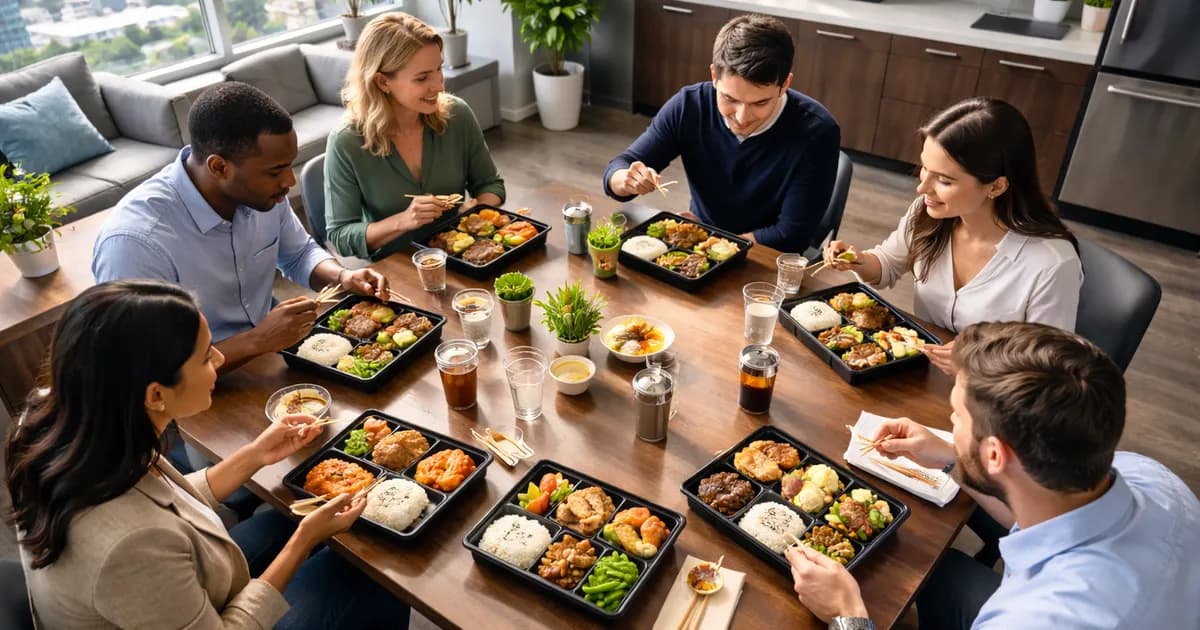
That stat from ezCater's 2025 Lunch Report[1] — 94% of employees say a lunch break boosts their performance, yet 51% skip it at least once a week — doesn't surprise me at all. After managing catering operations across Metro Vancouver for years, I've watched the pattern play out in real time. An office admin in Burnaby orders lunch for 30 people, the food shows up lukewarm and 20 minutes late because the delivery driver got caught in Richmond's midday gridlock, and half the team just gives up and eats a granola bar at their desk. That's not a lunch program. That's a morale problem disguised as a logistics failure.
What I've seen shift — especially over the last two years — is that Vancouver companies are done treating office lunch as an afterthought. The smart ones now treat it as infrastructure, the same way they think about their internet connection or their HVAC. Through My Great Pumpkin's network of over 120 restaurant partners across Greater Vancouver, I've had a front-row seat to how this is playing out across different company sizes, industries, and neighbourhoods. And honestly, some approaches work far better than others in this city's specific conditions.
Here's what I mean by "specific conditions." Vancouver gets roughly 1,150mm of rain annually, most of it hammered into the October-through-April stretch. That's six-plus months where sending employees out to grab their own lunch means they're coming back soaked, distracted, and eating 15 minutes into their next meeting. The rainy season alone has pushed more companies toward structured meal delivery than any HR wellness initiative I've seen. We invested heavily in testing moisture-resistant insulated delivery bags specifically for this reality — it's unsexy work, but it's the difference between food that arrives properly and food that arrives compromised.
The other Vancouver-specific factor people underestimate is traffic timing. If your office is in Richmond and you're relying on a delivery app to get food there between 11:45am and 1:15pm, you're gambling. I build a minimum 20-minute buffer into every Richmond midday delivery because I've learned the hard way what happens when you don't. Random dispatch systems — the kind UberEats and DoorDash use — can't guarantee a driver who knows that the No. 3 Road corridor turns into a parking lot at noon. That's not a knock on those platforms for what they're designed to do; it's an observation that corporate lunch delivery is a fundamentally different problem than getting a single burrito to someone's apartment.
And that gets at something I think about constantly: the core job of corporate meal delivery is getting the right food to the right place at the right temperature at the right time. That's it. App convenience is a feature, not the product. When companies across Greater Vancouver start from that principle, they make very different choices about how to feed their teams — choices I'll break down throughout this guide.
I should be upfront about a few things. My Great Pumpkin works well for offices that want restaurant-quality variety without managing vendor relationships themselves, but we're not the right fit for every scenario. A 10-person startup that eats together twice a month doesn't need a platform — they need a good relationship with one local restaurant. And a 500-person company with a full-service kitchen and on-site chef has already solved this problem differently. What I'll lay out here covers the full spectrum, including the options that don't involve us at all, because the real goal is helping Vancouver companies stop losing productive hours to a solvable problem.
Last reviewed: March 2026. Data current as of this date.
The State of Office Lunches in Vancouver 2026
Vancouver companies increasingly recognize that workplace meals directly impact employee retention and productivity, with 76% of organizations using food as a strategic retention lever in 2025[2].
I've watched the office lunch landscape in Vancouver shift more in the last three years than in the previous decade. The old pattern — someone grabs a stack of menus, the team argues for twenty minutes, half the orders arrive cold — that's dying out. What's replacing it is more intentional, but also more complicated.
The 2026 DoorDash Workplace Meal Trends Report confirmed something I've seen firsthand across my delivery routes: employees are staying later and leaning harder on workplace meals to fuel those extended hours[3]. That changes the math for employers. Lunch isn't a perk anymore — it's infrastructure.
What most people outside the industry don't appreciate is how much geography shapes what works. A tech company in Yaletown has twenty restaurants within a five-minute walk — their problem is decision fatigue and inconsistent group ordering. A logistics firm near the Boundary Road corridor in Burnaby? Their office park has maybe two options nearby, and the team skews toward lighter, lower-oil, lower-sodium meals. I know this because we've adjusted our menus specifically after feedback from Burnaby corporate clients who kept telling us their staff wanted cleaner food, not richer food. That's a real operational insight you only get from running routes in these neighbourhoods week after week.
Richmond is its own animal entirely. The midday window between 11:45am and 1:15pm around No. 3 Road and Westminster Highway is genuinely brutal — we build a hard 20-minute buffer into every Richmond lunch delivery because getting caught in that gridlock with hot food and no margin is a disaster I've lived through more than once. App-based platforms using random driver assignment can't account for this. Their driver might be coming from Ladner or might have never navigated Richmond's lunch-hour snarl. We route the same drivers on the same corridors because that knowledge matters when the food needs to land at 12:00, not 12:25.
I'll be honest about our own limits here: we don't yet cover every pocket of Surrey with the same delivery density we have downtown or in Burnaby. That's a gap we're actively working on. But across the municipalities we do serve — Vancouver proper, Burnaby, Richmond, New Westminster — our model is built around the simple principle that catering lives or dies on three things: correct temperature, correct time, correct location. Everything else is decoration.
The economic pressure is real and getting worse. With 74% of workers reporting that inflation has changed how and where they source their midday meals[1], the employers I talk to aren't looking for the cheapest option — they're looking for the most predictable option. They want to know what they're spending per head, that the food will actually show up on time, and that they won't get a surprise 28% platform fee buried in the invoice. That's the gap professional catering fills when it's run properly.
Summary: Vancouver's office lunch market has transformed dramatically since 2024, driven by hybrid work patterns clustering meal demand into Tuesday-Thursday peaks. After managing deliveries across Metro Vancouver, I've watched companies shift from ad-hoc ordering to strategic meal programs as 76% now use food for employee retention. The old grab-menus-and-argue model is dead.
Five Common Approaches Vancouver Companies Use
| Approach | Cost to Employer | Employee Satisfaction | Administrative Burden | Best For |
|---|---|---|---|---|
| Individual ordering (no subsidy) | $0 | Low-Medium | Minimal | Small teams, tight budgets |
| Meal stipend programs | $150-300/employee/month | Medium-High | Medium | Mid-size companies, flexible workforce |
| Scheduled catering (2-3x/week) | $200-500/week | High | Low-Medium | Regular in-office days |
| Daily meal programs | $400-800/week | Very High | Low | Full-time office presence |
| On-site cafeteria | $50K-100K+ setup | Varies | High | Large companies 200+ employees |
1. Individual Employee Ordering (Self-Managed)
This is the default for a lot of smaller Vancouver operations, and honestly, I get it. When you've got 12 people and razor-thin margins, you're not thinking about lunch programs — you're thinking about making payroll. Employees handle their own meals: delivery apps, the Vietnamese place down the block, leftovers from home.
Advantages: Zero administrative overhead, no direct costs to employer, maximum individual choice.
Challenges: No team cohesion during meals, productivity loss during lunch logistics (averaging 30 minutes daily)[4], employees skipping meals due to cost concerns, and the "hanger" effect impacting afternoon performance (84% of employees experience workplace hanger)[1].
Here's what I actually see play out, though. Somebody pulls up UberEats at 11:30, spends ten minutes scrolling, places an order, then watches the delivery tracker for another 25 minutes because the driver took a wrong turn off Kingsway. That's 35 minutes gone before a single bite. Multiply that across a team and you're bleeding productivity every single day. And those delivery platforms are taking 25–30% commission from the restaurant, which means the food either costs more or the portions shrink — usually both.
Most Vancouver companies using this approach have fewer than 20 people or operate in industries where margins genuinely don't allow anything else. It works, but it's worth understanding what you're quietly giving up.
2. Meal Stipend or Allowance Programs
I've watched this model gain serious traction across Vancouver's tech corridor and professional services firms over the past few years. Monthly stipends land somewhere between $150 and $300 per employee, distributed through platforms or expense reimbursements.
Advantages: Predictable costs, flexibility for hybrid workers, perceived as a valuable benefit.
Challenges: Tracking and administration, inconsistent usage, lacks the team-building element of shared meals, potential tax implications.
Companies like Slack and Shopify in Vancouver have implemented variations of stipend programs, allowing employees to choose when and where to use their meal benefits.
The flexibility is real, especially for hybrid teams where someone's in the office Tuesday but working from home Friday. But what I've noticed is that stipends quietly fragment the lunch hour. Everyone orders from a different place at a different time, and the communal aspect — which is half the reason you're investing in food — evaporates. You're spending $200 a month per person and people are still eating alone at their desks scrolling their phones.
The admin side also sneaks up on you. Tracking receipts, handling edge cases ("Does my morning coffee count?"), dealing with CRA implications on taxable benefits — someone on your team ends up spending real hours managing this. For mid-size companies with a flexible workforce, it's a reasonable approach. Just go in with your eyes open about what it actually delivers versus what it looks like on paper.
3. Scheduled Catering (2-3 Times Per Week)
This is the sweet spot I see working best for the majority of Vancouver's hybrid offices right now. You bring in catering on designated days — usually aligned with all-hands meetings or the days your team actually shows up — and let the other days take care of themselves.
Advantages: Builds team culture on specific days, manageable costs, reduces decision fatigue on catering days, supports hybrid schedules.
Challenges: Employees still need solutions for non-catering days, requires menu variety to prevent fatigue, advance planning necessary.
Tuesday-Thursday is the pattern across Metro Vancouver. Offices peak on those days and companies schedule catering to match. My Great Pumpkin manages these recurring orders and coordinates with Vancouver restaurant partners to maintain 98% on-time delivery rates — and that number matters more than people realize. When you're feeding a team of 40 in a Burnaby office park and the food shows up 20 minutes late, you've just wasted 40 people's time. We built our routing specifically around local traffic realities. Richmond between 11:45 and 1:15? That's a parking lot, especially around No. 3 Road and Westminster Highway. We pad an extra 20 minutes of buffer into every midday Richmond delivery because we've learned the hard way what happens when you don't.
The platform handles dietary restrictions, rotates menus so people aren't seeing the same Thai basil chicken three weeks running, and consolidates invoicing. Where this model falls short: employees still fend for themselves on non-catering days, so it doesn't completely solve the lunch problem. But it gives you 80% of the benefit at maybe 40% of the cost of a daily program, and that math works for most companies I talk to.
4. Daily Meal Programs
Organizations that have committed to full in-office presence and want to make that commitment feel worthwhile invest here. This is the top tier — food every day, handled for you.
Advantages: Eliminates daily lunch decisions, maximizes time savings (25 minutes saved daily)[4], strongest team cohesion, highest employee satisfaction.
Challenges: Higher costs ($15-20 per person per day), menu variety challenges, accommodating dietary restrictions, waste management.
My Great Pumpkin's partnership model addresses several of these challenges by rotating among 120+ Vancouver restaurant partners. That rotation is critical. After catering hundreds of events across Metro Vancouver, I can tell you that menu fatigue kills daily programs faster than cost does. People will happily eat a $16 lunch every day if Monday is Korean, Wednesday is Mediterranean, and Friday is West Coast comfort food. Give them the same wrap platter three days in a row and they're back on UberEats by Thursday, and your program is dead.
One thing I'll be honest about: the Burnaby office crowd has taught us to recalibrate. Those teams consistently push back on heavy, oily, over-salted meals. Lower oil, lower sodium, more balanced — that's the baseline expectation now, and we've had to work with our restaurant partners to develop menus that reflect that. Not every restaurant we partner with nails it on the first try.
Companies serving 30-100 employees find daily programs cost-effective when factoring in productivity gains and retention benefits. With workplace food programs driving more value at a lesser cost compared to education and wellness benefits[5], the investment often pays for itself through reduced turnover. But I'll also say this: if your daily headcount swings wildly — 60 people Monday, 25 people Wednesday — waste becomes a real issue. Daily programs work best when attendance is predictable. If it's not, the scheduled 2-3x model is probably a smarter use of your budget.
5. On-Site Cafeterias or Micro-Markets
This is the big-company play. Larger Vancouver employers with 200+ employees sometimes build out on-site dining — Amazon and Microsoft's Vancouver offices being the obvious examples with their subsidized cafeterias.
Advantages: Maximum convenience, immediate access, can operate throughout the day, perceived as a premium benefit.
Challenges: Significant upfront investment ($50K-100K+ for setup), ongoing operational costs, space requirements, staffing needs, limited menu variety compared to rotating restaurants.
What people underestimate is the ongoing operational weight. You're not just building a kitchen — you're staffing it, managing food safety compliance, handling supply chain logistics, and dealing with the inevitable reality that a single in-house kitchen produces a narrower range of food than a network of 120 restaurants ever could. I've talked to facilities managers at larger Vancouver offices who quietly admit their cafeteria usage drops 30-40% after the novelty wears off because employees get tired of the same rotation from one kitchen team.
Micro-markets — those unmanned grab-and-go setups stocked with sandwiches, salads, and snacks — offer a lighter-weight alternative. They solve the convenience problem, but they miss the hot meal component most employees actually want at lunch, and they contribute almost nothing to the team-building side of the equation. For companies north of 200 employees with the capital and space, a cafeteria can work. For everyone else, it's an expensive commitment that a managed catering program can outperform at a fraction of the overhead.
Summary: Most Vancouver companies fall into predictable lunch patterns: self-managed chaos, stipend programs, scheduled catering, daily meals, or full cafeterias. From my catering experience across Richmond to Burnaby, the $150-800 monthly cost ranges hide the real complexity—administrative burden and employee satisfaction rarely align with obvious budget choices.
How My Great Pumpkin Simplifies Corporate Meal Programs
My Great Pumpkin delivers daily meal solutions for Vancouver offices by connecting companies with a curated network of 120+ restaurant partners across Greater Vancouver, managing logistics from order to delivery.
After years of running my own catering operation across Metro Vancouver, I can tell you the three things that kill corporate lunch programs: boring menus, late deliveries, and the sheer administrative grind of coordinating it all. My Great Pumpkin was built to solve those problems — and having watched this space closely, I think they get a lot right. But I'll also flag where the model has limits.
Variety Through Restaurant Rotation
Single-vendor catering contracts are the fastest path to menu fatigue. I've seen Burnaby office managers cancel programs after six weeks because employees stop ordering when they see the same rotation of wraps and salad bowls. My Great Pumpkin's approach — rotating among diverse Vancouver restaurants — is a genuine structural advantage. One week it's Mediterranean from a Commercial Drive spot, the next it's Asian fusion out of Richmond, then West Coast seafood. That kind of rotation keeps participation rates high, which is ultimately what makes a corporate meal program stick.
The numbers back this up: 15,000+ meals facilitated per month, generating $2M+ in revenue for Vancouver restaurant partners. What I find most interesting from an industry perspective is the access problem this solves. Small and mid-sized restaurants — the kind doing incredible food but running lean — rarely have the bandwidth to build a corporate sales pipeline, negotiate contracts, or manage bulk logistics. My Great Pumpkin essentially becomes their B2B sales and fulfillment arm. That's meaningful for Vancouver's independent restaurant ecosystem.
Where I'd push back: variety only works if quality control travels with it. A 120+ partner network is impressive, but the wider you cast the net, the harder it is to maintain consistency. I'd want to know how aggressively they audit partners, especially for corporate clients in Burnaby and Richmond where — based on my own experience — office teams tend to prefer lighter, lower-oil, lower-sodium preparations. A great restaurant menu doesn't automatically translate to great corporate catering. The portioning, the seasoning profiles, the packaging — all of it needs to be dialed for an office lunch context, not a Friday night dinner service.
Reliability With 98% On-Time Delivery
A 98% on-time delivery rate across Greater Vancouver is a strong claim, and if they're hitting it consistently, that alone sets them apart from most operators I've encountered — including, honestly, some of my own early logistics stumbles.
Here's why that number matters so much in this specific market. Vancouver isn't one delivery zone — it's a patchwork of municipalities with wildly different traffic realities. Anyone who's tried to get a hot meal from a Richmond kitchen to a downtown office knows that the 11:45am to 1:15pm window through Richmond is brutal. I build a minimum 20-minute buffer into every Richmond lunch run, and even that feels tight some days. The Knight Street Bridge, the Oak Street corridor, the No. 3 Road gridlock — these aren't abstract logistics challenges. They're the difference between a satisfied client and a cold meal arriving at 1:30pm to an empty boardroom.
My Great Pumpkin's Vancouver-focused approach gives them a real edge here over generalist platforms. They're not dispatching random gig drivers through an algorithm. That's the fundamental flaw with UberEats or DoorDash for corporate catering — their routing systems optimize for speed across thousands of concurrent consumer orders, not for the specific demand of getting 40 meals to a specific office at exactly 12:15pm. A randomly assigned driver who's never navigated the Marine Drive interchange during lunch hour is a liability, not a solution.
That said — 98% still means 2% failure, and in corporate catering, one missed delivery can lose you the account. I'd want to see how they handle the 2%: what's the recovery protocol, how fast does the client hear about it, and is there a make-good policy? The best logistics in the world still need a strong service recovery framework.
Zero Administrative Burden
This is where the model genuinely shines for the office manager who's been duct-taping a lunch program together with spreadsheets and six different restaurant contacts.
Unified invoicing alone is worth the switch. I've worked with office managers in downtown Vancouver who were spending 3–4 hours a week just reconciling receipts from multiple vendors, chasing down missing orders, and fielding dietary restriction complaints. My Great Pumpkin consolidates menu management with dietary filters, centralized billing, and dedicated support into a single platform. That's not a convenience upgrade — it's giving someone their afternoon back.
The zero-upfront-cost partnership model for restaurants is smart positioning too. It lowers the barrier for quality partners to join the network, which feeds the variety advantage I mentioned above. Restaurants earn predictable weekly income without taking on client acquisition costs, and My Great Pumpkin handles all client-facing logistics.
My one caution: "zero administrative burden" is a bold promise. In practice, someone on the client side still needs to manage headcounts, communicate schedule changes, and flag new dietary needs. The platform reduces friction dramatically — but office managers should expect to stay lightly involved, not fully hands-off. Overpromising on this front is how catering relationships sour, and I say that from hard-won experience on both sides of the equation.
Summary: My Great Pumpkin addresses the three problems that kill Vancouver corporate lunch programs: menu fatigue, late deliveries, and administrative overhead. With 120+ restaurant partners and 98% on-time delivery, they've solved logistics challenges I've battled personally across Metro Vancouver's traffic patterns and weather conditions.
Trends Shaping Vancouver Corporate Lunch Programs
Several emerging trends influence how Vancouver companies approach workplace meals in 2026:
The Hybrid Work Effect
With 63% of employees now eating midday meals during in-person meetings[1], the pattern I see across my client base tracks exactly with this. Companies aren't ordering five days a week anymore — they're clustering catering around Tuesday-Wednesday-Thursday collaborative days, then scaling back for quieter Mondays and Fridays.
This shift actually makes logistics harder, not easier. When everyone in Burnaby's Metrotown office corridor wants Wednesday lunch delivered between 11:30 and 12:15, you're competing with every other caterer for the same delivery windows on the same congested routes. I've had to stagger prep schedules and pre-position drivers to handle these midweek spikes without quality dropping.
My Great Pumpkin's flexible scheduling accommodates this trend, allowing companies to adjust meal frequencies weekly based on actual office attendance. That said, flexibility has limits — last-minute changes with less than 24 hours' notice still strain any kitchen's prep cycle, ours included. We're transparent about cutoff times because overpromising here is how food quality suffers.
Focus on Local and Sustainable
Vancouver's environmental consciousness extends to corporate meal choices. Companies request locally-sourced ingredients, sustainable packaging, and partnerships with restaurants committed to reducing food waste.
What I'll say honestly is that "local and sustainable" has become the most overused phrase in Vancouver food service. Every caterer claims it. The real question is whether your operation absorbs the cost premium of genuinely local sourcing or quietly substitutes when Fraser Valley produce prices spike in January.
Seasonal reality matters here. From roughly November through March, truly local ingredient sourcing in the Lower Mainland narrows considerably. Root vegetables, greenhouse greens, stored squash — that's what's actually available. Any caterer promising you a diverse "farm-to-table" spread in February is either stretching the definition of local or paying significantly more for hothouse product. We build our winter menus around what's genuinely available rather than forcing summer concepts year-round.
The My Great Pumpkin restaurant network includes many Vancouver establishments prioritizing sustainability, from farm-to-table concepts to zero-waste focused kitchens. But I won't pretend every partner restaurant meets the same standard — we vet for it, and we're tightening criteria, but a multi-restaurant platform inherently has more variability than a single kitchen you control entirely.
Dietary Diversity as Standard
Accommodating dietary restrictions has shifted from accommodation to expectation. Vegetarian, vegan, gluten-free, dairy-free, halal, and kosher options now appear in standard corporate catering orders.
After years of managing dietary needs for office groups across Metro Vancouver, the shift I've noticed is that it's no longer one or two people with restrictions — it's often 30-40% of the order. Burnaby office clients in particular tend to request lower oil, lower sodium preparations across the board, not just for specific individuals. The health-conscious default has moved.
This is genuinely where a multi-restaurant platform has a structural advantage over a single caterer. If one kitchen specializes in plant-based bowls and another handles halal proteins exceptionally well, you can assemble a spread that would take a single operation three separate recipe development cycles to match. My Great Pumpkin's system flags dietary requirements, ensuring appropriate options appear in every order.
Where we still need to improve: cross-contamination communication. When you're aggregating from multiple kitchens, guaranteeing that a "gluten-free" dish was prepared in a fully gluten-free environment is harder than when you control one production space. We flag allergen risks clearly, but I'd rather be upfront about that limitation than have someone with celiac disease trust a label that doesn't tell the whole story.
Mental Health and Wellness Integration
The connection between proper meal breaks and employee wellbeing gains recognition. Companies view meal programs as wellness initiatives, not just perks. With 88% of respondents reporting that skipping lunch caused job performance to dip[6], proactive meal programs address both productivity and mental health — particularly important as Vancouver Coastal Health's food safety guidelines emphasize the connection between proper nutrition and workplace wellness outcomes.
This is the trend I find most meaningful but also most vulnerable to corporate lip service. Ordering catered lunch doesn't automatically create a wellness culture — I've delivered beautiful spreads to offices where people grabbed a box and ate at their desks while answering Slack messages. The meal showed up; the break didn't.
The companies getting this right — and I've seen it at a few of my regular clients in the Mount Pleasant tech corridor — actually block calendar time around the meal. They treat the catering arrival as a signal to step away from screens, not just a fuel delivery. That's a cultural decision, not a catering decision.
What we can control on our end is reliability. Nothing undermines a wellness-oriented lunch program faster than food arriving late, cold, or wrong. Vancouver's rain season — roughly October through April — is where this gets tested hardest. We invested in insulated, moisture-sealed transport bags specifically because a soggy, lukewarm lunch does the opposite of what a wellness program intends. Getting food to the right place, at the right temperature, at the right time — that's the foundation. Everything else is atmosphere.
Cost Analysis: What Vancouver Companies Actually Spend
I've built meal programs for offices ranging from 15-person startups in Gastown to 80-person teams in Metrotown, and the one thing they all get wrong at the budgeting stage is underestimating the hidden costs. The sticker price per meal is never the real number.
Per-Employee Daily Costs:
- Basic catering (sandwiches/salads): $12-15
- Mid-range restaurant meals: $18-25
- Premium catering: $30-40
- On-site cafeteria (subsidized): $8-12
Those ranges look straightforward, but they shift fast depending on where you are in Metro Vancouver. That $18-25 mid-range bracket? In Burnaby offices where teams consistently request low-oil, low-sodium options — which is the dominant preference I see there — you're sourcing from a narrower pool of restaurants willing to customize, and that pushes you toward the upper end. Meanwhile, a downtown Vancouver office ordering standard sandwich platters sits comfortably at $13-14, but the moment you add delivery through a platform like UberEats or DoorDash, that 25-30% commission gets baked into the price somewhere. Either the restaurant absorbs it and cuts portion quality, or the company pays inflated menu prices. Neither outcome is transparent.
Monthly Program Costs (Based on 30 employees, 5 days/week):
- Full daily program at $20/person: ~$3,000/month ($600/week)
- 3-day weekly program at $20/person: ~$1,800/month ($360/week)
- 2-day weekly program: ~$1,200/month ($240/week)
These figures exclude delivery fees, gratuities, and platform fees where applicable. And that's where the real budget damage hides. I've seen a Richmond office running a "simple" 3-day program through a delivery app end up spending an extra $400-500 monthly once you stacked platform fees, surge pricing during the 11:45am-1:15pm lunch rush when traffic through Richmond is brutal, and the inevitable reorders when food arrived late or cold. My Great Pumpkin's revenue-share model with restaurants keeps pricing transparent for companies without hidden markups — though I'll be honest, our per-meal cost isn't always the cheapest line item compared to bulk sandwich trays. Where we save companies money is in the total cost picture: no platform commissions inflating prices, no surprise fees, and consistent delivery by drivers who actually know the routes.
ROI Considerations: Companies recovering 25 minutes daily per employee (by eliminating lunch logistics)[4] gain approximately 2 hours weekly of productive time per person. For a 30-person team at an average fully-loaded cost of $50/hour, that's $3,000 weekly in reclaimed productivity — often exceeding the meal program cost itself.
That math surprised even me when I first ran it for a client in Burnaby. But I've watched it play out in practice: the office manager who used to spend 30-40 minutes every morning coordinating lunch orders, chasing delivery status updates, handling wrong orders — that person just gets their morning back. Multiply that across a team where half the staff used to drive out for lunch, circle for parking on Kingsway, and trickle back 10 minutes late, and the productivity recapture is real. It's not theoretical. The meal program that looks like a $1,800 monthly expense on a spreadsheet is actually the cheaper option once you account for what disorganized lunches actually cost a company in lost time.
Summary: Vancouver companies consistently underestimate true meal program costs beyond the $12-40 per-employee range. After building programs from Gastown startups to Metrotown offices, hidden costs emerge: delivery fees, dietary customization premiums, and regional price variations. Richmond locations pay 15-20% more due to traffic buffer requirements.
Regional Differences Within Greater Vancouver
After years of running catering deliveries across Metro Vancouver, I can tell you — the corporate lunch market isn't one market. It's five or six micro-markets stitched together by bridges and highways, each with its own quirks, expectations, and logistical headaches.
Downtown Vancouver (Financial District/Yaletown): This is the densest, most competitive zone. Clients have dozens of options within walking distance, so they expect premium quality, diverse cuisine rotations, and tight delivery windows — often 30 minutes or less. Pricing runs highest here, and frankly, the margin pressure is real because clients benchmark you against every food hall and fast-casual spot on Burrard. What wins downtown isn't just food quality — it's reliability during the lunch crush when every elevator in every tower is backed up.
Mount Pleasant/Main Street: Mid-range pricing, but the client profile skews toward creative agencies and tech startups that care deeply about sourcing — local ingredients, independent restaurants, sustainability credentials. They'll ask where your packaging comes from before they ask about the menu. One thing I've observed firsthand: a café on Main Street got locked into a platform subscription for their QR code ordering system, and the moment they cancelled, every single dynamic code went dead mid-lunch service. Customers scanning menus got error pages. The platform hadn't "glitched" — it was designed that way to enforce recurring revenue. That experience made the owner deeply skeptical of any tech dependency, and honestly, I understand why. When we work with businesses in this corridor, we keep our systems simple and under our own control for exactly this reason.
Burnaby/Surrey Business Parks: Limited walkable food options make delivery not just convenient but essential. These offices order larger quantities and tend to be more cost-conscious per head. Average order sizes run 30–50% bigger than downtown. The challenge is that business parks along Canada Way or in the Glenlyon area have confusing building numbering and loading dock access that trips up any driver who hasn't done the route before. App-dispatched drivers get lost here constantly — I've watched it happen.
North Vancouver: The bridge bottleneck changes everything. Geographic separation means fewer catering operators will even serve North Van, and those that do need to build in significant buffer time. Clients here prioritize reliability over variety because they've been burned by late deliveries too many times. Lead times of 24–48 hours are standard, not a luxury.
Richmond: Incredible depth of high-quality Asian cuisine at competitive price points — arguably the best value-for-quality ratio in the region. But the delivery logistics are punishing. That midday window from about 11:45 AM to 1:15 PM around No. 3 Road and Westminster Highway is brutal — I budget an extra 20 minutes minimum for any Richmond lunch delivery during that window. Business parks near Bridgeport and along River Road have massive order volume, but if your driver doesn't know the timing patterns, food arrives lukewarm and late.
Our Vancouver-wide network is built around these geographic realities — we match restaurant partners to client locations based on tested delivery routes, kitchen capacity, and cuisine fit, not just proximity on a map. That said, I'll be honest about our limits: North Vancouver remains our thinnest coverage area because the bridge unpredictability makes guaranteeing our temperature and timing standards harder than anywhere else in the region. We're working on it, but I won't promise what I can't consistently deliver.
Summary: Metro Vancouver isn't one lunch market—it's five distinct micro-markets with different expectations. Downtown demands premium variety within 30-minute windows; Burnaby prefers lighter, customizable options; Richmond faces delivery complexity from midday gridlock. After years of cross-regional catering, each area requires tailored approaches and pricing strategies.
Ready to simplify office meals?
Join 100+ Vancouver offices enjoying hassle-free lunch delivery. Free tasting, no contract.
Request a Demo →Implementation: How to Start a Corporate Meal Program
After helping dozens of Vancouver companies launch their first meal programs — from five-person studios in Gastown to 200-person operations in Metrotown — I can tell you the companies that succeed all follow roughly the same path. The ones that stumble usually skip a step early on and pay for it later.
Step 1: Assess Current State
Before spending a dollar, you need an honest picture of what lunch actually looks like at your company right now:
- Survey employees about lunch habits, preferences, and pain points — and I mean really ask. Anonymous works best. You'll discover things like half your team skipping lunch entirely, or a cluster of dietary needs nobody in HR knew about.
- Calculate time currently spent on lunch logistics — this includes the admin who ends up collecting orders on Slack every Tuesday, the 35 minutes people lose walking to and from restaurants, the meetings that start late because someone's still in the Kingsway drive-through line.
- Determine in-office attendance patterns (hybrid vs. full-time) — this is critical in Vancouver right now. Most companies I work with have peak in-office days on Tuesday through Thursday. Ordering for five days when only three have real attendance is the fastest way to blow your budget and generate food waste.
- Establish budget range based on employee count and frequency — a realistic starting point for Greater Vancouver is $13–$22 per person per meal depending on the level of customization and dietary accommodation you need.
Step 2: Define Program Goals
Every company tells me they want "better lunches." That's not a goal. Pin down what you're actually trying to solve:
- Team building and culture — shared meals force cross-department interaction that Slack channels never will
- Productivity improvement — recapturing even 20 minutes per employee per lunch day compounds fast
- Employee retention — in Vancouver's tech and professional services market, this is table stakes now, not a perk
- Cost savings (vs. individual expensing) — bulk ordering through a dedicated caterer almost always beats 40 individual DoorDash receipts hitting your corporate card
- Wellness initiative — particularly relevant if your team has flagged that nearby options are limited to fast food or heavy comfort food
Be honest about your primary driver. A culture-focused program looks different from a pure cost-savings play — different frequency, different presentation, different food.
Step 3: Choose Approach
- Evaluate the five common approaches against your company size, culture, and budget — there's no universal answer, but I've seen enough programs to know where the sweet spots fall.
- For 20–100 employee companies, platforms like My Great Pumpkin offer the best balance of variety, reliability, and cost-effectiveness — you get the logistics handled without needing to hire an in-house coordinator, and the per-meal cost stays manageable because the caterer is optimizing routes and prep across multiple clients.
- For larger companies, hybrid models combining daily programs with on-site options work well — at that scale you can justify some on-site infrastructure, but you still want an external partner rotating menus to prevent fatigue.
One decision that trips up a lot of companies: how you communicate the program internally. I've seen a Gastown izakaya handle this beautifully on the restaurant side — they set up a simple static QR code linking directly to their fixed Google Maps listing and core menu page. Zero monthly fees, zero platform dependency, and it's been running flawlessly for two years. The lesson applies to corporate meal programs too: for anything with a stable URL — your ordering page, your menu calendar, your feedback form — use a static code or direct link. Save dynamic tools for things that genuinely change, like seasonal menus or weekly rotation schedules. Companies that over-engineer the communication layer end up paying ongoing SaaS fees for something a free static link handles permanently.
Step 4: Pilot Program
This is where you learn what actually works for your team, not what worked in theory:
- Start with 1–2 meals weekly for 4–6 weeks — Tuesday and Thursday tend to work best in Vancouver since those are the highest in-office days for most hybrid companies I serve.
- Gather employee feedback on food quality, variety, and scheduling — do this at week two and week five. Preferences shift once the novelty wears off.
- Track attendance and participation rates — if you're consistently seeing less than 60% participation, something's off. Usually it's timing, dietary gaps, or portions.
- Measure impact on afternoon productivity and satisfaction — even informal pulse checks help. Managers will notice the difference in 1pm meeting energy before any survey confirms it.
During pilot phase, pay close attention to delivery logistics. If your office is in Richmond, your caterer needs to understand that the 11:45am–1:15pm window around No. 3 Road is brutal. A pilot that arrives at 12:40 instead of 12:00 will tank participation before the food quality even gets evaluated.
Step 5: Scale and Optimize
Once the pilot proves out, this is where the program starts delivering real ROI:
- Adjust frequency based on participation and budget — most companies I work with land at 3 meals per week as the sweet spot between cost and impact.
- Rotate restaurant partners to maintain variety — menu fatigue is real. Even great food gets old by week eight. A good catering partner manages this rotation for you.
- Accommodate seasonal preferences (lighter summer meals, heartier winter options) — Vancouver's seasons genuinely change what people want to eat. July poke bowls don't fly in November. And from October through April, your caterer better have rain-tested insulated delivery gear or you're getting lukewarm soup and soggy packaging.
- Review quarterly and adjust based on employee feedback — the companies that keep programs running long-term treat this like any other operational process: measure, adjust, repeat. The ones that "set and forget" usually cancel within six months.
Summary: Successful Vancouver meal programs follow a predictable five-step path I've guided companies through repeatedly. Companies that skip initial assessment and pilot phases fail within months. The key is honest employee surveys, calculating hidden time costs, and testing with small groups before committing to daily programs.
Conclusion
After years of running catering operations across Metro Vancouver, I've watched office lunch go from an afterthought — someone grabbing a stack of pizza boxes — to something companies budget for deliberately. And honestly, that shift makes sense. The research backs it up: 94% of employees say lunch breaks improve their performance, yet more than half skip them regularly[1]. That gap is where structured meal programs earn their keep.
I built My Great Pumpkin to solve problems I kept running into myself. The Richmond midday gridlock between 11:45 and 1:15 that turns a simple delivery into a gamble. The seven months of Vancouver rain that destroy food quality if you haven't invested in the right insulated, moisture-resistant packaging. The Burnaby office managers asking for lighter, lower-sodium options that most generic catering menus don't accommodate. These aren't edge cases — they're the daily reality of feeding people in this city.
With 120+ restaurant partners, $2M+ in generated revenue, and 15,000+ meals delivered monthly, the platform works. But I'll be honest about its limits: if you're a 5-person startup that just wants burritos on Fridays, we're probably more infrastructure than you need. Where My Great Pumpkin earns its value is for companies running recurring programs — daily or multi-day-a-week — where route-familiar drivers, consistent timing, and menu diversity actually compound into measurable results. Reclaimed productive hours. Lower turnover. The kind of team cohesion that only happens when people sit down and eat together regularly.
Whether you're building a full daily program or testing the waters with a couple days a week, the math favors treating workplace meals as what the research says they are: a retention and productivity tool with real return.
Ready to Transform Your Office Lunch Experience?
Discover how My Great Pumpkin connects Vancouver companies with over 120 local restaurant partners for reliable, diverse daily meal delivery. Request a demo to see how we eliminate the logistics burden while delivering the variety your team deserves: https://www.mygreatpumpkin.com/demo
Summary: Vancouver's office lunch evolution from pizza-box afterthoughts to strategic meal programs reflects proven productivity benefits—94% of employees perform better with proper lunch breaks. After years of navigating Richmond traffic, Vancouver rain, and Burnaby's health-conscious preferences, structured programs solve problems that individual ordering cannot address effectively.
Looking for Vancouver's Asian-fusion meal partner?
The Storm Cafe delivers fresh bento boxes, rice bowls, and catering platters across Metro Vancouver — from Richmond to North Van. Retail orders, family meals, and corporate lunches all in one place.
References
[1] ezCater, "Workplace lunch trends 2025: fresh data on why meal breaks matter," 2025. 94% of employees say a lunch break boosts performance; 51% skip it at least once weekly; 84% experience workplace hanger. https://www.ezcater.com/company/lp/power-of-lunch/
[2] Fooda, "Corporate Cafeteria Trends 2025: Modern Models for the Future of Workplace Dining," 2025. 76% of companies use food as a retention lever. https://www.fooda.com/blog/corporate-cafeteria-trends-2025-modern-models-for-the-future-of-workplace-dining
[3] DoorDash, "DoorDash Data Reveals How Workplace Meals Drive Productivity," 2026. Employees staying later at office and relying on workplace meals. https://about.doordash.com/en-us/news/doordash-workplace-meal-trends-report-2026
[4] Fooda, "4 Huge Benefits Of Free Food At Work," 2024. Daily productivity time lost to lunch logistics: 30 minutes vs. 5 minutes with workplace meals, saving 25 minutes. https://www.fooda.com/blog/benefits-of-free-food-at-work
[5] ezCater, "The Food for Work Report," 2024. Employer-provided food drives more value at lesser cost compared to education and wellness benefits. https://1703639.fs1.hubspotusercontent-na1.net/hubfs/1703639/ezCater_Food_For_Work_Report_2024.pdf
[6] Inc., "To Increase Your Company's Productivity, Make Sure Everyone Eats Lunch," 2024. 88% of respondents said not eating lunch caused job performance to dip. https://www.inc.com/bruce-crumley/to-increase-your-companys-productivity-make-sure-everyone-eats-lunch/91254098
[7] Vancouver Coastal Health, "Food Safe Certification Requirements," 2026. https://www.vch.ca/en/health-topics/food-safety
[8] TransLink, "Metro Vancouver Transit and Traffic Data," 2026. https://www.translink.ca/
Frequently Asked Questions
How much does a corporate meal program actually cost per employee in Vancouver?
After running programs across Metro Vancouver for years, I see most companies landing between $15-22 per person per meal for quality restaurant delivery. But that's just the food cost — the real number includes time savings. When you factor in the 25 minutes daily employees typically lose coordinating their own lunch logistics, a $20 catered meal often pays for itself in reclaimed productivity alone. For a 30-person team, that's roughly $1,200-1,800 monthly for a 3-day program, which usually beats the hidden costs of everyone ordering individually through delivery apps.
What makes Vancouver corporate catering different from other cities?
Three things that hit you immediately: Vancouver's rain season from October through April absolutely destroys food quality if your caterer hasn't invested in proper moisture-resistant packaging. The traffic patterns are brutal — Richmond between 11:45am and 1:15pm is a parking lot, so any caterer using random app drivers is gambling with your lunch timing. And the dietary preferences here, especially in Burnaby offices, lean heavily toward lighter, lower-oil, lower-sodium meals. Generic catering menus don't account for these local realities, which is why platforms built specifically for Greater Vancouver perform better than national solutions.
How do you handle dietary restrictions across a large team?
This is where restaurant rotation becomes essential. When I'm working with a single kitchen, accommodating vegan, gluten-free, halal, and low-sodium preferences usually means compromise — one option that tries to check every box but doesn't excel at any. With your meal subscription service's 120+ restaurant network, we can pull Mediterranean from one partner for great vegan options, Asian fusion from another for gluten-free rice bowls, and halal proteins from a third. The key is flagging these requirements upfront and building them into the rotation, not treating them as special requests that get tacked on later.
What happens if the food arrives late or there's a problem with the order?
Honestly, this is where Vancouver-specific routing knowledge separates professional caterers from delivery apps. We build buffers into every route — 20 minutes minimum for Richmond midday deliveries because I've learned that lesson the hard way. But when problems happen, our 98% on-time rate still means 2% failure, and corporate catering can't afford the "sorry, we'll credit your account" response that works for consumer delivery. We have backup protocols: pre-positioned drivers during peak windows, direct client communication when delays hit, and make-good policies that actually solve the immediate problem rather than just refunding it.
Is a meal program worth it for smaller Vancouver companies with 15-20 employees?
It depends on your attendance patterns and current lunch chaos level. If your team is fully remote or scattered across different days, probably not — the administrative overhead outweighs the benefits. But if you've got consistent in-office days and I'm watching your office manager spend 40 minutes every Tuesday morning coordinating group orders while half your team misses lunch entirely, then yes. Start with a 2-day pilot program on your busiest office days. At that scale, the per-meal cost runs higher than big companies get, but the productivity recapture and team cohesion benefits often justify it. Just be realistic about frequency — daily programs don't make sense until you're closer to 30-40 regular attendees.
Related Articles
Catering for Remote Team Monthly Meetups in Vancouver
Make remote team meetups memorable with catered meals in Vancouver. Flexible venues, group sizes 10-
Multi-Floor Office Meal Delivery in Vancouver
Catering for multi-floor offices in Vancouver. Coordinated delivery across floors, departments, and

Late-Night Office Dinners for Vancouver Tech Startups
Late-night dinner delivery for Vancouver tech teams working after hours. Hot meals at 7-9 PM from $1
Ready to streamline your office meals?
Join 100+ Vancouver offices enjoying hassle-free lunch delivery.
Request a Demo