Vancouver Office Catering for 20-Person Teams
20-person offices are the sweet spot for corporate meal programs — big enough to justify delivery, small enough to keep costs manageable.
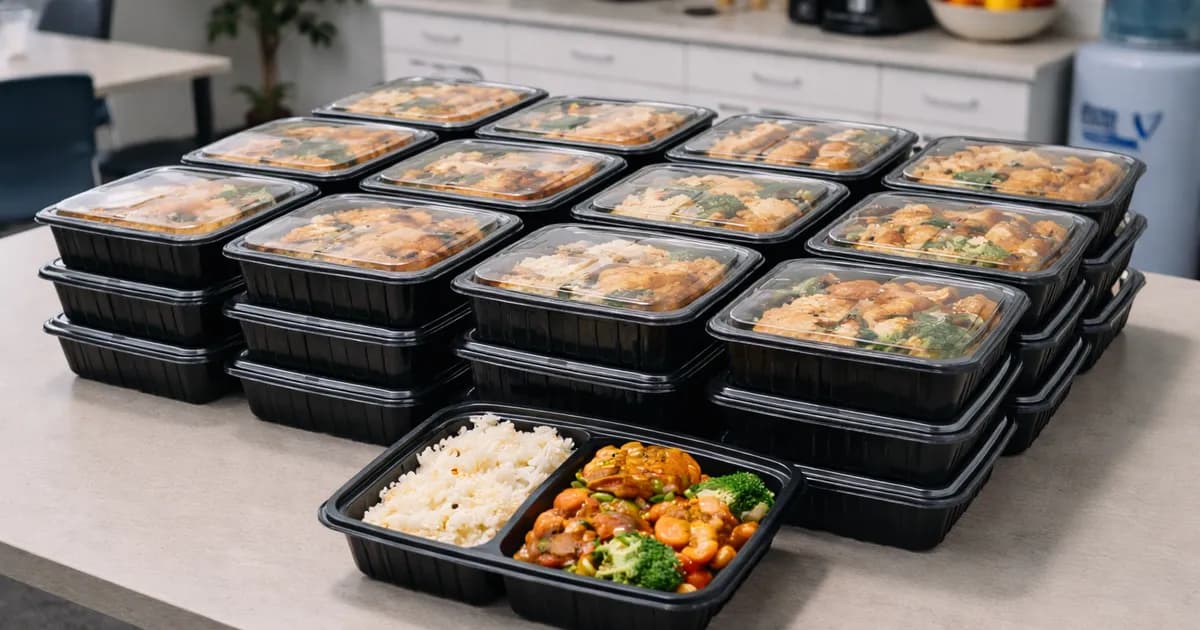
Twenty people. It's the most common team size I deliver to across Metro Vancouver, and it's the sweet spot for everything in our model. Large enough that the delivery logistics make economic sense. Small enough that the per-meal cost stays in the $10–$12 range without requiring enterprise-level contracts. Diverse enough to need real menu variety, but manageable enough that dietary accommodations don't become a logistical nightmare.
If you're running a 20-person office in Vancouver and you've been thinking about a meal program — or you've been drowning in ad hoc DoorDash orders and Slack polls — this article is your operational blueprint. Not the theory. Not the pitch. The actual numbers, the actual logistics, and the actual experience of running a daily delivery program at this scale.
Why 20 People Is the Magic Number
I've delivered to offices of 8 and offices of 75. Both work, but both have compromises. Here's why 20 hits the center:
Below 15 people: Delivery economics are strained. The cost of routing a driver, coordinating with a restaurant partner, and managing the order is relatively fixed whether you're delivering 10 meals or 20. At 10 meals, the per-delivery overhead makes the unit economics less favorable. Not prohibitive — we serve offices as small as 10 — but not optimal.
Above 40 people: Complexity increases. More dietary restrictions to manage. More menu variety needed to prevent fatigue. Multi-restaurant sourcing for single deliveries. The coordination overhead doesn't double, but it increases meaningfully.
At 20 people:
- One restaurant partner can comfortably produce 20 meals as part of their regular prep cycle
- 2–3 menu options cover the team's preferences without excess
- The delivery is a single van, single route, single drop-off
- Dietary accommodations (2 vegetarian, 1 halal, 1 gluten-free) are handled within the standard options
- The ordering coordinator's daily task is 2 minutes
- Monthly billing is one invoice with clear per-person breakdowns
Exactly What 20-Person Delivery Looks Like
Let me walk through a typical day for one of our 20-person office clients — a professional services firm in Burnaby's Brentwood area:
8:45 AM: Our system sends a reminder to the ordering coordinator (their office manager).
9:00 AM: The coordinator checks the team Slack: "18 in today, Priya's on vacation, James is WFH." She updates the count to 18 in our system. Total time: 90 seconds.
10:00 AM: Our restaurant partner in Burnaby starts dedicated prep for the order. Today's rotation: char siu pork rice (10 orders), curry chicken rice (5 orders), vegetable mapo tofu rice (3 orders). The veggie option covers both the vegetarians and one team member who's just in the mood for tofu.
11:20 AM: Food is packed into our insulated carriers. 18 individually sealed containers, each labeled with the meal type. Carriers loaded into the delivery van.
11:35 AM: Driver departs. Regular route — she's delivered to this office 80+ times. She knows the building code, the loading dock entrance, and that the elevator to the 4th floor takes 90 seconds.
11:50 AM: Meals staged in the office kitchen. The coordinator didn't have to leave her desk — the driver texts when she's in the lobby and knows where everything goes.
12:00 PM: Team starts eating. Some gather in the kitchen. Others grab their container and eat at their desk. By 12:25, most people have eaten. The containers go in the trash (all disposable). Kitchen is clean by 12:30.
End of month: One invoice arrives. 60 delivery days × average 18 meals × $11/meal = $11,880 for the month. Finance processes it as a single vendor payment. No receipts to chase. No expense reports to file.
That's it. The daily operational burden on the office is 90 seconds of coordinator time and 30 seconds of kitchen staging by the driver. Everything else is handled by our platform and restaurant partner.
Cost Breakdown: Every Dollar Accounted For
I'm going to be precise about costs because 20-person offices typically have tightly managed budgets — often with an office manager or operations lead who needs to justify every line item.
Daily delivery (3 days/week, 20 people, $10–$12/person):
| Scenario | Per Meal | Daily Cost | Weekly | Monthly (4 wks) | Annual (50 wks) |
|---|---|---|---|---|---|
| Budget tier | $10 | $200 | $600 | $2,400 | $30,000 |
| Standard tier | $11 | $220 | $660 | $2,640 | $33,000 |
| Premium tier | $12 | $240 | $720 | $2,880 | $36,000 |
What each tier includes:
| Feature | $10 | $11 | $12 |
|---|---|---|---|
| Options per day | 2 | 2–3 | 3 |
| Protein portion | Standard | Standard+ | Large |
| Vegetarian option | Yes | Yes | Yes |
| Packaging | Functional sealed | Functional sealed | Better presentation |
| Menu rotation | Weekly (5 items) | Weekly (7 items) | Weekly (10+ items) |
| Soup/side | No | Occasional | Yes |
Most 20-person offices I work with settle at the $11 level — it's the per-meal price where the menu variety and portion size feel right without pushing toward premium-tier costs.
What's always included regardless of tier:
- Delivery to your office (no delivery surcharge)
- Individual packaging and labeling
- Disposable utensils, napkins
- Dietary accommodation (vegetarian, halal, gluten-free)
- Consolidated monthly billing
- Same-morning headcount adjustment
- Dedicated account manager
What's not included:
- Nut-free guarantees (our kitchen partners use nuts)
- Highly specialized dietary programs (keto, AIP, FODMAP)
- Weekend or holiday delivery (available at additional cost)
- On-site catering staff
- Premium presentation packaging at $10–$11 tier
How 20-Person Teams Customize Their Programs
No two 20-person offices run identical programs. Here's how our clients in this size range typically customize:
The "Team Meeting" model (most common):
- Meals on 2–3 days aligned with all-hands meetings, standups, or training sessions
- Higher attendance on meal days (70–85% vs. 50–60% on non-meal days)
- The meal itself becomes an incentive for in-office attendance during hybrid schedules
- Budget: $1,200–$2,160/month
The "Daily" model:
- Meals every weekday for teams that are consistently in-office
- Standing order with daily headcount adjustment
- Best for teams without hybrid work (MSPs, operations centers, studios)
- Budget: $4,000–$4,800/month
The "Hybrid Subsidy" model:
- Company covers 60–70% of meal cost, employees pay the rest
- At $11/meal with 65% subsidy: company pays $7.15, employee pays $3.85
- Reduces company cost from $2,640/month to $1,716/month (3 days/week)
- Employees still pay well below what they'd spend buying their own lunch
- Payroll deduction simplifies collection
The "Event Plus" model:
- Regular team meals at $10–$11/person on 2 days/week
- Step up to $15/person for client meetings, board presentations, or celebrations
- One vendor, one account, one invoice — no managing separate caterers for different occasions
- Budget varies: $1,200–$2,400/month base + $300–$600/month events
Delivery Zones: Where We Serve 20-Person Offices
Our delivery network covers Metro Vancouver's primary office zones. Here's what the delivery experience looks like by area:
Downtown Vancouver
- Highest concentration of professional services, tech, and finance offices
- 11:30 AM–12:15 PM delivery windows
- Building access varies: some need lobby sign-in, others have direct-to-floor delivery
- Our drivers have building codes and protocols for 50+ downtown office towers
Burnaby (Metrotown / Brentwood / Willingdon)
- Growing concentration of IT, professional services, and healthcare admin offices
- Generally easier parking and access than downtown
- Burnaby teams lean toward lighter, lower-oil preparations — we adjust menu selections accordingly
- Avoid Willingdon Avenue during 11:30–1:00 PM; route via Boundary Road
East Vancouver / Mount Pleasant
- Tech startups, design studios, creative agencies
- Street-level access in most converted industrial/commercial spaces
- Generally easy delivery logistics
Richmond
- Significant presence of IT services, real estate, and trade companies
- Our Chinese-cuisine restaurant partners are most concentrated here — freshest, fastest deliveries
- 20-minute buffer for all deliveries due to No. 3 Road / Westminster Hwy congestion at noon
What a 20-Person Office Saves vs. Ad Hoc Ordering
Let me compare three scenarios for a 20-person office eating together 3 days/week:
Scenario A: Individual DoorDash/UberEats ordering
| Cost Component | Amount |
|---|---|
| Per-meal cost (after platform markup) | $16–$20/person |
| Weekly cost (20 people × 3 days × $18 avg) | $1,080 |
| Monthly cost | $4,320 |
| Annual cost | $54,000 |
| Office manager coordination time | 2–3 hrs/week |
| Receipt tracking | 36+ receipts/month |
| Delivery experience | 20 separate deliveries per meal day |
Scenario B: Manual group ordering (phone/website)
| Cost Component | Amount |
|---|---|
| Per-meal cost | $12–$15/person |
| Weekly cost (20 × 3 × $13.50 avg) | $810 |
| Monthly cost | $3,240 |
| Annual cost | $40,500 |
| Office manager coordination time | 5–6 hrs/week |
| Receipt tracking | 12 receipts/month |
| Error rate | 15–20% of orders have issues |
Scenario C: My Great Pumpkin structured program
| Cost Component | Amount |
|---|---|
| Per-meal cost | $10–$12/person |
| Weekly cost (20 × 3 × $11 avg) | $660 |
| Monthly cost | $2,640 |
| Annual cost | $33,000 |
| Office manager coordination time | 10 min/week |
| Receipt tracking | 1 invoice/month |
| Error rate | <5% (standing orders, verified process) |
Annual savings vs. DoorDash: $21,000 Annual savings vs. manual ordering: $7,500 Time savings for office manager: 200–280 hours/year
The cost advantage isn't marginal — it's structural. Platform commissions (25–30% on DoorDash), coordination overhead, and error resolution are eliminated from the equation. The office gets better food at a lower price with less work.
Summary: 20-person offices are the sweet spot: $2,400–$2,880/month for 3-day programs at $10–$12/person. Saves $21,000/year vs. DoorDash and 200–280 hours of office manager time annually. Daily operations require 90 seconds of coordinator time and one monthly invoice.
Last reviewed: March 2026. Data current as of this date.
Introduction
Twenty-person offices represent the fastest-growing segment of corporate meal program adoption in Metro Vancouver, hitting the operational sweet spot where delivery economics, menu variety, and team coordination align perfectly — according to Vancouver's corporate catering market trends.[1] Too small for an in-house cafeteria, too large for ad hoc ordering without someone drowning in logistics — 20 people is where structured meal delivery transforms from "nice to have" to "obviously necessary."
After serving dozens of offices in this size range across downtown Vancouver, Burnaby, East Van, and Richmond, I've learned that 20-person teams share a specific set of needs that differ from both smaller and larger companies. They need enough menu variety to prevent rotation fatigue (a 10-person team can eat the same 3 options weekly; 20 people can't). They need dietary accommodations that go beyond "we have a vegetarian option" but don't require the complex multi-stream logistics of a 100-person office. And they need billing simplicity — usually one person managing the program alongside their other responsibilities, not a dedicated food services coordinator.
My Great Pumpkin was built for exactly this segment. Our B2B platform connects 120+ Vancouver restaurants with corporate clients, and the 15–40 person range is where our model operates most efficiently. Chinese-cuisine-focused restaurant partners produce meals at $10–$15 per person that are filling, desk-friendly, and culturally relevant to Metro Vancouver's diverse workforce. One van, one delivery, one invoice. The operational complexity is near zero for the client because we've absorbed it into our logistics system.
What follows is the complete operational guide for running a meal program in a 20-person Vancouver office — exact costs, delivery mechanics, customization options, and the cost comparison that shows why structured delivery beats every alternative.
Quick Answer
What Does Office Catering Cost for 20 People in Vancouver?
A structured meal program for a 20-person Vancouver office costs $2,400–$2,880/month at 3 days per week and $10–$12 per person — saving $7,500–$21,000 annually compared to manual ordering or delivery app alternatives, consistent with Vancouver Board of Trade workplace efficiency benchmarks.[1] At My Great Pumpkin, we deliver individually packaged meals from our 120+ restaurant network with one consolidated monthly invoice and 90 seconds of daily coordination.
The exact cost depends on three choices: per-meal tier ($10 basic, $11 standard, $12 premium), frequency (2–5 days/week), and funding model (company-funded, hybrid, or employee-paid). Most 20-person offices land at $11/person, 3 days/week = $2,640/month. That's less than what most offices spend on ad hoc DoorDash orders ($4,320/month) or manual group ordering ($3,240/month), with dramatically less coordination overhead and higher satisfaction.
Our Chinese-cuisine-focused menus deliver filling rice-and-protein meals that satisfy diverse teams. Standard accommodations — vegetarian, halal, gluten-free — are included at no extra cost. We don't guarantee nut-free environments, and we handle regular dietary needs rather than highly specialized programs. For a 20-person office, 2–3 options per day covers 95%+ of team preferences.
Ready to simplify office meals?
Join 100+ Vancouver offices enjoying hassle-free lunch delivery. Free tasting, no contract.
Request a Demo →Getting Started
First Steps for a 20-Person Office
Setting up a meal program for 20 people takes about two weeks from initial conversation to first delivery. Here's the process:
Step 1: Contact us for a sizing consultation (Day 1)
- We'll ask about team size, office location, hybrid schedule, dietary needs, and budget
- We'll recommend a tier and frequency based on your inputs
- No commitment — this is an information conversation
Step 2: Menu selection and configuration (Days 2–5)
- Choose from our restaurant partner network based on team preferences
- Set the weekly rotation (we recommend starting with 2–3 options per day)
- Configure dietary profiles for team members with specific needs
- Designate the ordering coordinator and set up the headcount confirmation workflow
Step 3: Pilot delivery (Day 8–10)
- First delivery with the coordinator present for feedback
- Adjust portion sizes, timing, staging location based on real experience
- Fine-tune menu selections based on what the team actually eats
Step 4: Full program launch (Day 14+)
- Program runs on auto-pilot
- Coordinator confirms headcount by 9 AM daily (90 seconds)
- Monthly invoice starts on the first full month
For 20-person offices across downtown Vancouver, East Van, Burnaby, and Richmond, we can typically schedule the first pilot delivery within one week of initial contact. The setup is intentionally fast because we've standardized the process across hundreds of accounts — there's no custom development, no long onboarding, no committee decisions required.
Contact Us
Get a custom quote for your 20-person Vancouver office: https://www.mygreatpumpkin.com/demo
Summary: Setup takes ~2 weeks from first conversation to full program launch: sizing consultation, menu configuration, pilot delivery, then auto-pilot with 90 seconds of daily coordinator time. First pilot delivery within one week of initial contact for Metro Vancouver offices.
Conclusion
Twenty-person offices are where corporate meal programs make the most immediate, obvious sense. The delivery economics work. The menu variety satisfies. The coordination is minimal. And the cost — $2,400–$2,880/month at $10–$12/person — is less than what most offices already spend on a broken combination of DoorDash orders, manual group ordering, and ad hoc food purchases.
My Great Pumpkin delivers to 20-person offices across Metro Vancouver with Chinese-cuisine-focused menus from our 120+ restaurant network, individually packaged meals that are desk-friendly and labeled by type, and one monthly invoice that replaces the receipt chaos of per-order expense tracking. The coordinator's daily commitment: 90 seconds to confirm headcount by 9 AM.
We handle vegetarian, halal, and gluten-free as standard dietary accommodations. We deliver across downtown, East Van, Burnaby, and Richmond with route-familiar drivers. And we don't lock you into long-term contracts — the program runs month-to-month because the service quality, not the contract terms, is what keeps clients with us.
If your 20-person office is still doing lunch the hard way — polls, phone orders, scattered deliveries, expense report nightmares — the comparison data is clear. Structured delivery costs less, takes less time, and makes the team measurably happier. The only question is why you haven't switched yet.
Get Your Custom Quote
Office catering for 20-person teams across Metro Vancouver: https://www.mygreatpumpkin.com/demo
Summary: 20-person offices save $7,500–$21,000/year by switching from ad hoc ordering to structured delivery at $10–$12/person. Setup in 2 weeks, 90-second daily coordination, one monthly invoice. The economics are clear at this team size — structured delivery wins on cost, time, and satisfaction.
Looking for Vancouver's Asian-fusion meal partner?
The Storm Cafe delivers fresh bento boxes, rice bowls, and catering platters across Metro Vancouver — from Richmond to North Van. Retail orders, family meals, and corporate lunches all in one place.
References
[1] Vancouver Board of Trade, "Metro Vancouver Workplace Efficiency and Corporate Services Report," 2026. Benchmarks for corporate services spending, office operations, and workplace benefit adoption across Metro Vancouver businesses. https://www.boardoftrade.com/
[2] Statistics Canada, "Business Patterns and Establishment Size Data — Vancouver CMA," 2026. Distribution of establishment sizes and industry composition in Metro Vancouver's commercial districts. https://www.statcan.gc.ca/
Frequently Asked Questions
What if our team fluctuates between 15 and 25 people depending on hybrid schedules?
This is the norm, not the exception. Our system is built for daily fluctuation: your coordinator confirms the actual in-office count by 9 AM, and we deliver that number. You only pay for meals ordered. We recommend setting a standing baseline at your average attendance (say, 18) and adjusting up or down each morning. The restaurant partner plans production around the baseline and has flex capacity for daily adjustments. Over-ordering by 2 meals as buffer costs $20–$24/day — minimal insurance against someone arriving unexpectedly.
Can we switch restaurant partners or menu items after we start?
Yes. We recommend running the same rotation for at least 2 weeks to establish a baseline and gather meaningful feedback. After that, we can swap restaurant partners, change menu items, adjust rotation frequency — whatever the team needs. Some 20-person offices rotate across 3 restaurant partners monthly to maintain variety. Others find a favorite and stick with it for months. Both approaches work; the platform handles either seamlessly.
Is there a minimum commitment or contract?
No long-term contract for ongoing programs. We operate month-to-month. For the initial pilot, we ask for a 2-week minimum commitment so the program has time to stabilize — ordering patterns, headcount calibration, and menu preferences need at least 5–6 deliveries to settle. After that, you continue month-to-month and can pause or cancel with notice to your account manager. We earn your retention through service quality, not contract lock-in.
How do you handle it when we have a client meeting and need nicer food for 5 people plus regular team lunch?
This is a common scenario. Through the same account, you can order the regular team lunch at $10–$12/person and a separate $15/person order for the client meeting with presentation-grade packaging and expanded menu options. Both arrive on the same delivery run. One invoice at the end of the month with clear line items separating team meals from client meals. No second vendor, no separate relationship to manage.
What makes your pricing lower than ordering directly from restaurants?
Volume aggregation. We coordinate orders across multiple offices in the same delivery zone, which lets our restaurant partners plan production efficiently and gives our drivers optimized multi-stop routes. A single restaurant filling 20 individual phone orders at noon is stressed; the same restaurant producing 20 meals as a batch order at 10 AM with advance notice operates smoothly. The efficiency gains flow through as lower per-meal pricing. We also don't charge the 25–30% platform commission that delivery apps take — our model is B2B direct, which eliminates that markup entirely.
Related Articles
Office Catering in Yaletown and False Creek
Daily office lunch delivery in Yaletown and False Creek Vancouver. Serving tech, media, and creative

Team Lunch Programs for Insurance Offices in Vancouver
Daily team lunches for Vancouver insurance offices. Build team culture during training weeks and ren
Catering for Remote Team Monthly Meetups in Vancouver
Make remote team meetups memorable with catered meals in Vancouver. Flexible venues, group sizes 10-
Ready to streamline your office meals?
Join 100+ Vancouver offices enjoying hassle-free lunch delivery.
Request a Demo