Skip The Dishes for Business vs. Dedicated Meal Programs
Compare Skip The Dishes for Business against dedicated corporate meal programs for Vancouver offices. Real cost breakdowns, delivery reliability data, and admin burden analysis for 30-person teams.
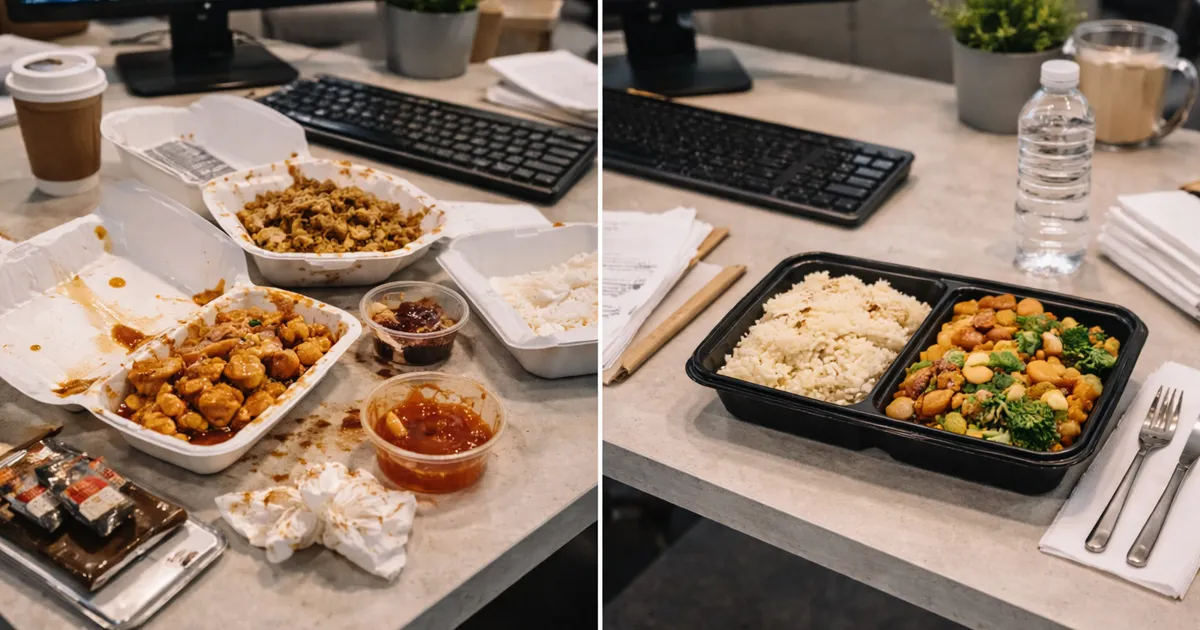
I've been watching Skip The Dishes carve into the Vancouver corporate meal market for the past couple of years, and I'll give them credit where it's earned — the brand recognition alone gets them through doors that dedicated caterers have to fight for. When an office manager Googles "office lunch delivery," Skip is already on their phone. That's a real advantage, and pretending otherwise would be dishonest.
But here's what I keep coming back to after years of running My Great Pumpkin's catering operations across Metro Vancouver: the app that's easiest to open isn't necessarily the service that delivers the best outcome when thirty people are standing around a boardroom at 12:15 waiting for lunch. Those are two completely different problems. One is a consumer convenience problem. The other is a logistics and food operations problem. And in Vancouver — with our specific traffic patterns, our rain, our loading dock situations — the gap between those two problems is wider than most office managers realize until they've lived through a few bad Thursdays.
The question I hear most often from office managers comparing these two models isn't "which one has more restaurants?" It's "which one will actually show up on time with hot food, consistently, without me spending three hours a week managing it?" That's the question this comparison is built to answer.
Last reviewed: March 2026. Data current as of this date.
What Skip The Dishes for Business Actually Offers
Skip The Dishes has built a strong consumer brand in Canada — it's the delivery app most Canadians recognize, and that familiarity extends into corporate accounts. Their business platform lets companies set up meal allowances, expense policies, and group ordering through the same app employees already use for personal orders. The restaurant selection across Metro Vancouver is genuinely broad — hundreds of options spanning every cuisine category.
I'll be straightforward about what they do well:
- Brand recognition: Employees already know how to use the app. Zero training required.
- Restaurant variety: Hundreds of Vancouver-area restaurants, from chains to independent spots.
- App convenience: Individual ordering means each person picks exactly what they want.
- Flexible commitment: No long-term contracts, pay-per-order model.
- Expense integration: Corporate accounts with spending limits and basic reporting.
Those are legitimate strengths, and for certain scenarios — a one-off Friday team lunch, a startup with five people who all want different things — Skip works fine. Where the model starts to strain is when you're running a recurring meal program for a 30-person office, which is exactly the scenario most of my corporate clients face.
The Cost Reality: Breaking Down
What a 30-Person Office Actually Pays
This is where the conversation gets uncomfortable for app-based platforms, and it's where I want to be extremely specific because vague cost comparisons help nobody.
Let me walk through real numbers for a 30-person office ordering lunch, comparing Skip The Dishes for Business against a dedicated meal program like ours.
Let me break those numbers down honestly.
Skip The Dishes side: Each person orders individually. The average lunch on Skip runs $18-20 per person once you account for the inflated menu prices — restaurants on delivery platforms typically mark up their prices 15-25% to offset the 25-30% commission Skip takes on every order. Then you add delivery fees ($4-6 per individual order), a service fee (roughly 10% of the order subtotal), and a tip (most people tip $3-5 for a lunch delivery). For 30 people ordering three times a week across a month, that's 360 individual transactions. The costs stack: food alone is $6,840, delivery fees add $1,800, service fees another $684, and tips push you past $10,000 per month.
Dedicated meal program side: At My Great Pumpkin, we work with a flat per-person rate — typically $10-15 per person depending on the menu tier, with $13 being the midpoint for a solid rotating lunch program. That rate includes delivery. No service fees. No tipping required. For 30 people, three times a week, twelve deliveries per month: $4,680. That's it. The number on the invoice is the number you pay.
The gap isn't 10%. It's closer to 55%. And the reason is structural, not because we're magically cheaper on food. When you consolidate 30 individual orders into one bulk delivery, you eliminate 29 delivery fees, 30 service charges, 30 tips, and the entire commission markup that inflates menu pricing on the platform. That overhead doesn't go toward better food — it services the platform.
I should be fair here: Skip's per-order model makes sense when you're buying lunch for yourself. The economics don't scale for group feeding. That's not a flaw in their business — it's a design choice for a different use case.
Ready to simplify office meals?
Join 100+ Vancouver offices enjoying hassle-free lunch delivery. Free tasting, no contract.
Request a Demo →Delivery Reliability: Gig Drivers vs. Dedicated Routes
This is the section where Vancouver's specific geography matters more than any pricing spreadsheet.
Skip The Dishes, like all gig delivery platforms, uses an algorithmic dispatch system. When your office places 30 individual orders, the platform assigns whoever happens to be available and nearby. That driver might be coming from Kitsilano to deliver to your Richmond office. They might be stacking your order with two other deliveries along the way. They almost certainly don't know that No. 3 Road between Cambie and Westminster Highway turns into gridlock between 11:45am and 1:15pm every single weekday.
I know this because I've driven those routes hundreds of times. We build a minimum 20-minute buffer into every Richmond lunch delivery during that window — not because we're being cautious, but because we've learned exactly what happens when you don't. A random Skip driver making their third delivery of the hour doesn't have that institutional knowledge, and the app's estimated arrival time doesn't account for it.
The staggered arrival problem is worse than the late arrival problem. When 30 people order individually through Skip, those orders leave from different restaurants at different times. Some arrive at 11:50, some at 12:20, some at 12:45. Half the team finishes eating before the other half has food. The "team lunch" becomes 30 people eating alone at their desks over a 45-minute window. That's not a shared meal experience — it's parallel individual eating with a corporate credit card.
With a dedicated program, one driver — our driver, who's run this route before — brings everything in a single delivery at a scheduled time. The food arrives together. The team eats together. That sounds simple, but it's the entire operational promise of corporate catering, and it's genuinely hard to execute without route familiarity, proper insulated equipment, and weather-tested packaging.
Vancouver's rain is the other variable most platforms ignore. We get roughly 1,150mm of annual rainfall, concentrated from October through April. That's six-plus months where every handoff between vehicle and building entrance is a chance for food quality to degrade. We invested in moisture-resistant insulated delivery bags after watching too many soggy deliveries — and not from our own drivers. I'm talking about what I've seen from platform couriers carrying standard thermal totes through a November sideways rain. Condensation inside the bag, damp packaging, lukewarm food. For a one-off personal dinner delivery, maybe that's tolerable. For a recurring corporate lunch program where your team is judging the company's investment in their experience? That's a visible failure.
I'll be honest about where Skip's delivery model actually outperforms ours: truly spontaneous orders. If a meeting runs long and your team suddenly needs food in 45 minutes with no advance planning, a gig platform can mobilize faster than we can. Our model requires at least 24-48 hours of lead time because we're coordinating with restaurant partners on prep quantities and route-planning drivers for efficiency. That trade-off — spontaneity for reliability — is real, and the right choice depends on how your office actually operates.
The Admin Burden Nobody Talks About
Here's what I hear from office managers more than anything else: "I didn't sign up to become a lunch coordinator."
With Skip The Dishes for Business, someone — usually the office manager or an HR coordinator — has to:
- Set up and manage 30 individual spending limits
- Monitor whether employees are staying within policy
- Reconcile 360 individual transactions per month (30 people x 3 lunches x 4 weeks)
- Handle disputes when orders arrive wrong, late, or not at all
- Chase down missing receipts for accounting
- Field complaints about cold food, incorrect orders, and delivery delays
That admin load is real, and it's not on Skip's marketing page. I've talked to office managers in Burnaby who were spending four to five hours per week on lunch logistics alone — not because they were inefficient, but because managing 30 individual delivery experiences is inherently more complex than managing one.
With a dedicated meal program, the office manager's involvement looks like this:
- Approve the weekly menu (takes about 5 minutes)
- Confirm headcount by the day before (one message)
- Receive one consolidated invoice per month
That's it. We handle the restaurant coordination, the dietary accommodations, the delivery logistics, and the customer support. If something goes wrong — and things do go wrong, I won't pretend otherwise — your single point of contact is our account manager, not a chatbot queue shared with a million consumer orders.
The time savings alone often justifies the switch. When an office manager gets back five hours a week, that's 20 hours a month of productive work recovered. For most companies, the dollar value of that recovered time exceeds the meal cost savings.
Dietary Management: Individual
Choice vs.
Coordinated Curation
Skip's model gives each person complete control over their meal selection, which means dietary restrictions are handled individually. Someone with celiac disease can filter for gluten-free options. Someone who's vegan can order from a plant-based restaurant. That autonomy is a genuine advantage, and I respect it.
Where the individual model breaks down is coordination. When 30 people order from 15 different restaurants, there's no unified quality standard for allergen handling. One restaurant might take cross-contamination seriously. Another might not. There's no single point of accountability if someone gets sick, because the food came from a dozen different kitchens with a dozen different food safety practices.
With our program at My Great Pumpkin, we work with a curated network of 120+ Vancouver restaurant partners whose food safety protocols we've personally reviewed. When a team tells us they have three people with nut allergies and five who need halal options, we build that into the menu rotation from day one. The same kitchen prepares the food every week, so the risk of a miscommunication about allergens drops significantly. Our partners learn your team's restrictions and adjust proactively — that relationship depth simply doesn't exist when you're ordering from a different restaurant every day through an app.
I'll be transparent about our limitation here: if someone on your team has a very niche dietary need that doesn't fit our partner network's capabilities, they may feel constrained. In that case, supplementing with an individual app order for that one person while running the bulk program for everyone else is a perfectly reasonable hybrid approach.
Invoicing and Expense Reporting
For finance teams, this comparison is almost comically lopsided.
Skip The Dishes for Business generates individual receipts for every order. Even with their corporate dashboard, you're looking at 360 separate line items per month for a 30-person office doing three weekly lunches. Reconciling those against spending policies, flagging overages, matching them to department codes, and producing clean reports for accounting — that's a real workload. Skip's expense integrations help, but they're built for consumer-scale tracking, not for the kind of consolidated corporate reporting that a finance director actually wants to see.
A dedicated meal program generates one invoice per delivery — twelve per month, or one consolidated monthly statement depending on the provider. At My Great Pumpkin, we issue clean, itemized invoices with headcount, menu details, and per-person cost breakdowns. One PO, one vendor relationship, one reconciliation cycle. I've had finance controllers tell me this alone was worth the switch, because the time their accounts payable team was spending on 360 micro-transactions per month was absurd relative to the actual meal spend.
Where Skip The Dishes Genuinely Wins
I've laid out the dedicated program advantages in detail, so let me be equally specific about where Skip is the better choice:
Small, unpredictable teams. If your office has 8 people and you never know who's coming in on any given day, the overhead of a dedicated program doesn't make sense. Skip's pay-per-order model is perfect for this — you only pay when someone actually orders.
Maximum variety seekers. Some teams genuinely want a different cuisine every single day, and no curated menu rotation can match the sheer breadth of a marketplace with hundreds of restaurants. If individual choice is your team's top priority, Skip delivers on that promise.
Multi-city operations. Skip operates across Canada. If your company has offices in Vancouver, Calgary, and Toronto and wants one platform for all three, Skip can do that. We can't — My Great Pumpkin is purpose-built for Greater Vancouver, and stretching beyond our delivery network would compromise the reliability we've spent years building.
Zero-commitment testing. If your company has never offered a meal benefit and wants to test the concept with minimal risk, Skip's no-contract model lets you experiment without any lock-in. That's a legitimate advantage for companies still figuring out whether a meal program is even worth running.
When a Dedicated Program Is the Clear Winner
The decision tips heavily toward a dedicated meal program when:
You're feeding 20+ people regularly. At this scale, the cost differential becomes thousands of dollars per month. The operational simplification — one delivery instead of 30, one invoice instead of 360 — is dramatic.
Delivery timing matters. If your team has a fixed lunch window and food needs to arrive hot and together at a specific time, a dedicated route with a familiar driver will outperform gig dispatch every time. This is especially true for Richmond and Burnaby offices where midday traffic creates real delivery risk.
You care about food arriving at temperature. During Vancouver's October-through-April rain season, the difference between purpose-built insulated delivery equipment and a standard courier bag is the difference between a hot meal and a lukewarm disappointment. Six months of the year, this factor alone tips the scale.
Admin time is valuable. If your office manager's time is better spent on something other than reconciling hundreds of individual delivery receipts, the operational simplification of a dedicated program pays for itself.
Team culture matters. A shared meal where everyone eats together builds different bonds than 30 people eating alone at their desks from 30 different restaurants. If your meal program is partly a culture investment, the delivery model matters as much as the food itself.
The Honest Middle Ground
The smartest office managers I work with across Metro Vancouver don't treat this as an either/or decision. They use a dedicated program for the structured, recurring meals — the Tuesday and Thursday team lunches, the monthly all-hands, the client meeting catering — and keep Skip or another app platform available for spontaneous needs, remote work days, or individual perks.
That hybrid approach captures the cost savings and reliability of dedicated catering where it matters most, while preserving the flexibility of app ordering where it makes sense. A Burnaby office running three weekly team lunches through us and giving employees a $15 Skip allowance on remote Fridays is getting the best of both models without forcing either one to do a job it wasn't designed for.
If your office is in Greater Vancouver and you're running the numbers on your current Skip spend, I'd genuinely encourage you to compare. We offer free consultations to map out what a dedicated program would look like for your specific headcount, dietary needs, and schedule — and if the math says Skip is a better fit for your situation, I'll tell you that. I'd rather be honest about fit than overpromise and underdeliver. That's the whole philosophy behind how we run our routes, our menus, and our relationships with the 120+ restaurant partners who trust us with their corporate catering revenue.
Explore My Great Pumpkin's Corporate Meal Solutions
Discover how My Great Pumpkin helps Vancouver businesses implement reliable, recurring corporate meal programs with local restaurant partners. Request a demo to see how the platform can deliver predictable meal solutions for your team: https://www.mygreatpumpkin.com/demo
Calculate your meal budget
Not sure which meal delivery option fits your budget? Our free calculator compares meal kits, prepared meals, restaurants, and home cooking side-by-side in CAD.
Frequently Asked Questions
How much cheaper is a dedicated meal program compared to Skip The Dishes for a 30-person office?
For a 30-person office ordering lunch three times a week, the difference is substantial. Through Skip, you're typically paying $18-20 per person in inflated menu prices, plus $4-6 in delivery fees per order, plus service fees and tips — which pushes the effective cost to around $28-29 per person per meal. A dedicated program like My Great Pumpkin runs $10-15 per person all-inclusive, with no delivery fees, no service charges, and no tipping. That works out to roughly $5,700 in monthly savings, or close to $69,000 annually. The gap comes from eliminating 30 individual delivery fees, removing the 25-30% platform commission that inflates restaurant pricing, and consolidating everything into a single efficient delivery.
Is Skip The Dishes delivery less reliable than a dedicated meal service in Vancouver?
In my experience operating across Metro Vancouver, yes — particularly during peak lunch hours and rain season. Skip uses algorithmic dispatch that assigns whichever driver is closest, regardless of whether they know your area's traffic patterns. Richmond between 11:45am and 1:15pm is a specific problem — No. 3 Road and Westminster Highway gridlock hard, and a driver unfamiliar with the corridor can blow a 15-minute estimate by 25 minutes. We build a mandatory 20-minute buffer into every Richmond lunch delivery because we've learned that lesson repeatedly. The other issue is staggered arrivals: 30 individual Skip orders come from different restaurants at different times, so your "team lunch" arrives across a 45-minute window rather than all at once.
Can Skip The Dishes handle dietary restrictions better since employees choose their own meals?
Skip gives individuals complete control over their food selection, which works well for personal dietary preferences. However, there's no coordinated quality standard for allergen handling across dozens of different restaurant kitchens. With a dedicated program, we build dietary restrictions into the menu rotation from the start — our restaurant partners learn your team's specific needs and adjust proactively. For teams with serious allergies, having one accountable kitchen that knows your restrictions is meaningfully safer than hoping fifteen different restaurants all handle cross-contamination properly. That said, for very niche dietary needs that fall outside our partner network's capabilities, supplementing with an individual app order for that person is a reasonable hybrid approach.
What about the admin work of managing 30 individual Skip orders versus one catering delivery?
The administrative burden is dramatically different. With Skip for Business, someone has to manage 30 individual spending limits, reconcile roughly 360 separate transactions per month, handle disputes for wrong or late orders, chase missing receipts, and field complaints. Office managers I've talked to in Burnaby report spending four to five hours weekly on lunch logistics alone. With a dedicated program, the admin involvement drops to approving a weekly menu, confirming headcount the day before, and receiving one consolidated monthly invoice. The recovered time — roughly 20 hours per month — often has a dollar value that exceeds the meal cost savings themselves.
When does Skip The Dishes actually make more sense than a dedicated meal program?
Skip is genuinely the better choice in several scenarios. If your team is small (under 10-12 people) with unpredictable attendance, the economics of dedicated delivery don't pencil out. If individual variety is your team's top priority and people want to order from different restaurants every day, no curated program can match that breadth. If you have offices in multiple Canadian cities and need one platform nationwide, Skip covers that geography while we're focused exclusively on Greater Vancouver. And if you've never offered a meal benefit and want to test the concept with zero commitment, Skip's pay-per-order model lets you experiment without any lock-in. The honest answer is that each model solves a different problem, and the right fit depends on your team size, schedule predictability, and what you're trying to accomplish with the meal program.
Related Articles
Catering for Remote Team Monthly Meetups in Vancouver
Make remote team meetups memorable with catered meals in Vancouver. Flexible venues, group sizes 10-
Multi-Floor Office Meal Delivery in Vancouver
Catering for multi-floor offices in Vancouver. Coordinated delivery across floors, departments, and

Late-Night Office Dinners for Vancouver Tech Startups
Late-night dinner delivery for Vancouver tech teams working after hours. Hot meals at 7-9 PM from $1
Ready to streamline your office meals?
Join 100+ Vancouver offices enjoying hassle-free lunch delivery.
Request a Demo