How to Scale Office Meals from 20 to 200 People
Scaling office meals from 20 to 200 people isn't linear — logistics compound, costs shift, and what worked at 20 breaks at 50. Here's how to navigate every breakpoint.
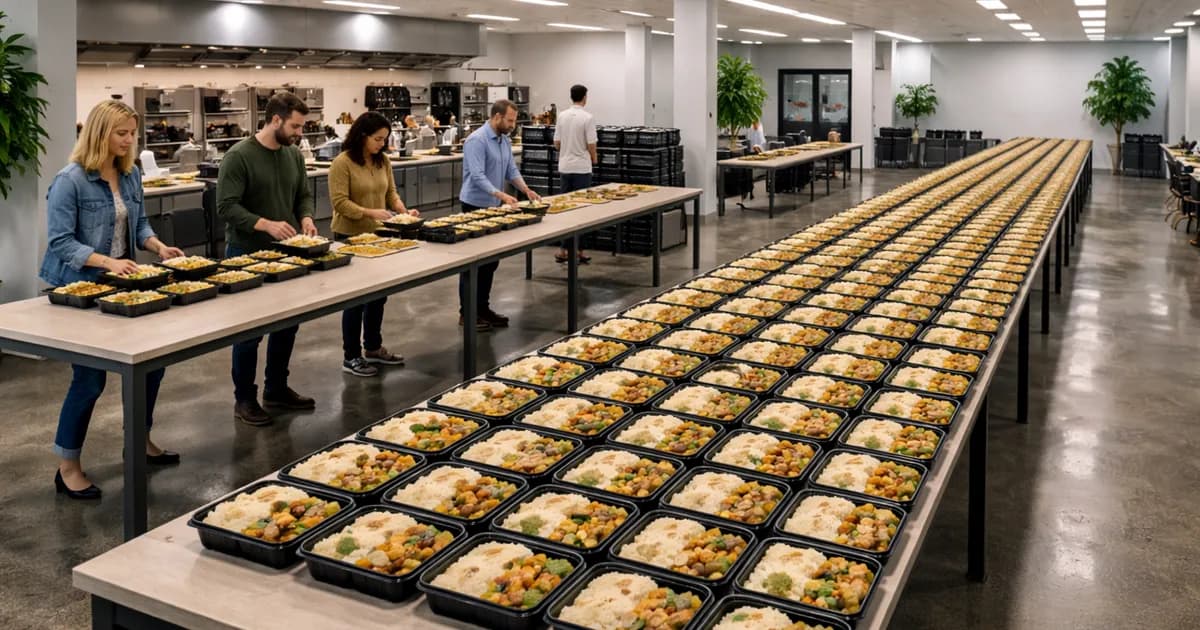
I've been running corporate meal delivery across Metro Vancouver for long enough to watch companies grow. A 20-person startup in Mount Pleasant signs up, everything runs smoothly — one restaurant partner, one van, one delivery coordinator spending 90 seconds a day. Then they hire. They expand into a second floor. They acquire another team in Burnaby. And somewhere around person number 45, the office manager calls me in a mild panic because the system that worked perfectly for 20 people is falling apart.
This is the article I wish every growing company's operations lead would read before they hit that wall. Because scaling office meals isn't linear. It's a step function with specific breakpoints where everything changes — the logistics model, the vendor strategy, the cost structure, the internal coordination requirements. I've guided dozens of Vancouver companies through each of these transitions, and the pattern is remarkably consistent.
Here's what actually happens at every stage, what breaks, and how to fix it before it breaks.
The Scaling Curve Nobody Warns You About
Most office managers assume that feeding 200 people is just feeding 20 people ten times. It's not. Not even close.
The relationship between team size and operational complexity is non-linear. Complexity accelerates — each additional person adds more coordination overhead than the one before, because you're not just adding a meal, you're adding a dietary preference, a delivery timing constraint, a menu fatigue variable, and a budget line item. Meanwhile, the per-person cost actually decreases because fixed logistics costs (driver, van, route, coordination platform) get spread across more meals.
This creates an interesting tension: the bigger you get, the cheaper each meal becomes, but the harder it gets to deliver them. The companies that scale successfully are the ones that invest in logistics infrastructure ahead of the complexity curve, not after it overwhelms them.
That chart tells the whole story. The red line — operational complexity — rises steeply through each breakpoint. The green line — cost per person — steadily declines as volume increases. The companies that scale successfully are the ones that see the breakpoints coming and restructure their meal program before the complexity overwhelms them.
Let me walk through each stage.
Stage 1: The 20-Person Sweet Spot ($10-$12/person)
Twenty people is where most corporate meal programs begin, and for good reason. At this scale, everything is elegant in its simplicity:
What works effortlessly:
- One restaurant partner handles the full order as part of their regular production cycle
- Two to three menu options cover the team's preferences
- Single van, single route, single drop-off point
- Dietary accommodations (usually 2-3 people with specific needs) are handled within the standard menu options
- The office manager or admin spends 90 seconds a day confirming headcount
- One invoice per month, clear per-person breakdown
Typical costs in Vancouver:
| Component | Amount |
|---|---|
| Per meal | $10-$12 |
| Daily (20 people) | $200-$240 |
| Weekly (3 days) | $600-$720 |
| Monthly | $2,400-$2,880 |
| Annual (50 weeks) | $30,000-$36,000 |
At this stage, the office manager barely thinks about the meal program. It just runs. The restaurant partner knows the order pattern. The driver knows the building code, the elevator, the kitchen layout. The team has settled into their preferences. Autopilot.
The warning sign that you're outgrowing this stage: Your office manager starts hearing complaints about menu fatigue. With 20 people and two options per day, preferences are easily covered. But as you approach 30-35, the probability of someone being genuinely dissatisfied with both options on any given day increases sharply. When the Slack channel starts getting comments like "rice bowls again?" from people who've been eating the same rotation for eight weeks — you're about to hit the first breakpoint.
Stage 2: The 50-Person Threshold — Where Everything Changes ($9.50-$11/person)
Fifty people is the first real breakpoint, and it catches almost every growing company off guard. Here's why:
A single restaurant can't reliably produce 50 meals as a side operation. At 20 meals, your order fits within a restaurant's normal production flow. At 50, you need a dedicated production run — and not every restaurant partner has the kitchen capacity, the prep staff, or the ingredient supply chain to handle that volume daily without quality degradation. By the third week, portions start shrinking slightly. The protein quality dips. Delivery timing slips by 10-15 minutes because the kitchen is overwhelmed.
The solution: multi-restaurant sourcing. This is the single biggest operational shift in the scaling journey. Instead of relying on one restaurant, we coordinate across two or three partners for a single delivery. Restaurant A produces 25 rice-based meals. Restaurant B produces 15 noodle dishes. Restaurant C handles the 10 specialized dietary orders. All three production runs are synchronized for a single pickup route, consolidated into one delivery van, and arrive at your office as a unified meal service.
From the team's perspective, nothing changes — food arrives at noon, there are more options, and the quality is consistent. But behind the scenes, the logistics have fundamentally shifted from a single-vendor arrangement to a coordinated supply chain.
What changes at 50 people:
| Factor | At 20 | At 50 |
|---|---|---|
| Restaurant partners | 1 | 2-3 |
| Menu options per day | 2-3 | 4-5 |
| Dietary restrictions to manage | 2-3 people | 6-10 people |
| Delivery vehicles | 1 small van | 1 large van |
| Coordination time (office) | 90 seconds/day | 5-10 minutes/day |
| Coordination time (vendor) | Minimal | Significant |
| Monthly cost (3 days/week) | $2,640 | $5,700-$6,600 |
| Invoice complexity | Simple | Moderate |
The dietary diversity explosion is the other factor that hits hard at 50. With 20 people, you might have one vegetarian and one person who eats halal. The base menu covers them naturally. With 50 people in a Vancouver office, you're statistically likely to have: 3-5 vegetarians, 2-3 who eat halal, 1-2 gluten-free requirements, 1 vegan, someone who's lactose intolerant, and someone with a shellfish allergy. That's not two accommodations within a standard menu — that's a parallel production stream.
At My Great Pumpkin, we handle this by routing specific dietary orders to restaurant partners whose menus naturally align. Our halal orders go to certified halal partners. Gluten-free meals come from partners whose rice-based menus are inherently gluten-free. This isn't about adding dietary labels to the same food — it's about building a sourcing network where accommodation is structural, not an afterthought.
Real cost breakdown at 50 people:
| Scenario | Per Person | Daily | Monthly (3 days/wk) |
|---|---|---|---|
| Budget multi-restaurant | $9.50 | $475 | $5,700 |
| Standard program | $10.50 | $525 | $6,300 |
| Premium with dietary streams | $11.00 | $550 | $6,600 |
Notice the per-person cost has already dropped from the $10-$12 range to $9.50-$11. That's the volume effect — fixed delivery costs spread across more meals. A 50-person delivery doesn't cost twice as much as a 20-person delivery. The driver, the van, and the route are largely the same. The marginal cost is almost entirely food.
Stage 3: The 100-Person Inflection — You
Need a Logistics Coordinator ($8.50-$10/person)
One hundred people is where corporate meal delivery transitions from "a perk the office manager handles" to "a program that needs its own operational owner."
I've watched this transition happen repeatedly across growing Vancouver companies — particularly tech firms in downtown and Mount Pleasant that scale from 40 to 120 over 18 months. The pattern is always the same:
- The office manager was handling the meal program as one of fifteen responsibilities
- The program grows with the headcount
- Around person 80-90, the office manager's meal-related tasks start consuming 30-45 minutes per day
- Menu planning, headcount coordination across multiple floors or teams, dietary tracking, feedback management, vendor communication, invoice reconciliation — each task is small, but they compound
- Something falls through the cracks: a floor gets the wrong order, a dietary restriction is missed, the invoice doesn't match the delivery records
- The office manager tells HR or operations leadership that either the meal program needs dedicated management or it needs to be simplified dramatically
What changes at 100:
Multi-floor delivery logistics. A 20-person office is one kitchen, one staging point. A 100-person operation typically spans multiple floors or departments, each with its own delivery window and staging area. Our driver doesn't make one drop — they make three or four, timed to match each team's lunch schedule.
Dedicated account management on our side. At the 20-person level, your account is one of dozens running through our standard coordination system. At 100, you get a named account manager who handles menu planning, dietary changes, delivery scheduling, and issue resolution. Not because we want to offer premium service for the sake of it — because the coordination complexity genuinely requires a dedicated human being paying attention to your account.
Menu rotation planning becomes a discipline. At 20 people, a weekly rotation of 5-7 dishes works for months before fatigue sets in. At 100 people eating 3-5 days per week, you need a monthly rotation of 25-30 unique dishes to prevent the "we had this last Tuesday" complaint cycle. That means coordinating across 4-5 restaurant partners, each contributing their specialties to a unified menu calendar.
Cost structure at 100 people:
| Component | Amount |
|---|---|
| Per meal | $8.50-$10 |
| Daily (100 people) | $850-$1,000 |
| Weekly (3 days) | $2,550-$3,000 |
| Monthly | $10,200-$12,000 |
| Annual (50 weeks) | $127,500-$150,000 |
At this budget level, the meal program shows up as a meaningful line item in the company's operating expenses. The CFO starts paying attention. Which is actually good news — because it means the program gets evaluated on ROI rather than treated as petty cash. And the ROI data is compelling: reduced time spent on lunch logistics, higher in-office attendance on meal days, and measurable retention impact when meal programs are part of the compensation narrative.
What your operations lead should demand at this scale:
- Monthly menu planning sessions (not reactive, week-by-week coordination)
- A dietary accommodation database for all team members
- Delivery confirmation with timestamps for each drop point
- Monthly reporting: cost per person by department, participation rates, satisfaction scores
- Quarterly business reviews with the catering partner
If your meal delivery vendor can't provide these at 100 people, they're running a 20-person service at 100-person volume, and it will break.
Stage 4: The 200-Person Enterprise — A Different Animal Entirely ($7.50-$9/person)
At 200 people, you're not running an office meal program anymore. You're running a food service operation. The distinction matters because the skills, systems, and vendor relationship required at this scale bear almost no resemblance to what worked at 20.
The reality of 200-person meal delivery in Vancouver:
Multi-site is almost unavoidable. Very few Vancouver offices have 200 people in one location eating lunch at the same time. More commonly, it's 120 downtown plus 50 in Burnaby plus 30 in Richmond — or 200 in one building but spread across seven floors with staggered lunch times from 11:30 to 1:00 PM. Either way, you're managing multiple delivery routes, multiple staging points, and multiple coordination touchpoints.
Restaurant sourcing becomes supply chain management. Producing 200 meals daily requires 5-8 restaurant partners operating in concert. Each partner contributes a category — Chinese rice boxes, noodle specialties, Indian curries, Western options, dietary-specific meals — and production is scheduled against a master menu calendar that rotates on a 4-6 week cycle. A single restaurant dropping out of the network (kitchen fire, staffing shortage, seasonal closure) requires an immediate substitute, which is why we maintain backup partners for every category.
Budget negotiations change fundamentally. At $7.50-$9 per person, a 200-person program running 5 days a week costs $150,000-$180,000 annually. That's a procurement-level contract, not an office manager's discretionary budget. The conversation moves from "can we afford this?" to "what's the service level agreement?" Companies at this scale expect:
- Guaranteed delivery windows with penalties for late arrival
- Minimum satisfaction scores with remediation plans
- Quarterly pricing reviews tied to volume guarantees
- Disaster recovery — what happens if the delivery van breaks down at 11:15 AM?
- Data reporting: participation analytics, cost-per-department breakdowns, dietary compliance tracking
Full cost comparison across all four stages:
| Factor | 20 people | 50 people | 100 people | 200 people |
|---|---|---|---|---|
| Per person | $10-$12 | $9.50-$11 | $8.50-$10 | $7.50-$9 |
| Restaurant partners | 1 | 2-3 | 4-5 | 5-8 |
| Menu options/day | 2-3 | 4-5 | 5-7 | 7-10 |
| Delivery vehicles | 1 | 1 | 1-2 | 2-3 |
| Internal coordination | 90 sec/day | 5-10 min/day | 30-45 min/day | Dedicated coordinator |
| Monthly (3 days/wk) | $2,640 | $6,300 | $10,800 | $19,800 |
| Annual (3 days/wk) | $33,000 | $78,750 | $135,000 | $247,500 |
| Vendor relationship | Transactional | Managed | Dedicated account | Strategic partnership |
The Mistakes Companies Make at Every Breakpoint
I've seen the same failure patterns dozens of times. Here are the most common, mapped to the scale where they typically occur:
At 30-40 people (approaching the 50 threshold):
- Sticking with one restaurant too long. The restaurant that was perfect for 20 is drowning at 40. Quality drops gradually, so nobody notices until it's a real problem. The fix: start multi-restaurant sourcing at 35, before you need it urgently.
- Not formalizing dietary tracking. At 20, the office manager knows "Sarah is vegetarian and Ahmed eats halal." At 40, it's impossible to track informally. Build a simple database or spreadsheet before it becomes a crisis.
At 60-80 people (approaching the 100 threshold):
- Treating meal coordination as a side task. The office manager who was spending 90 seconds a day at 20 people is now spending 30-45 minutes, and it's pulling them away from their actual job. This is when companies either hire a dedicated coordinator or transition to a vendor who absorbs most of the coordination (like us).
- Not renegotiating pricing. The per-person rate you locked in at 25 people shouldn't be the same at 75. Volume earns discounts. If your vendor hasn't proactively offered better pricing as you grew, they're overcharging you.
At 150-180 people (approaching enterprise):
- Running multiple independent vendors. Downtown office uses one caterer, Burnaby uses another, Richmond a third. Each has different pricing, different quality, different invoicing. Consolidating to a single platform that manages multi-site delivery creates consistency and unlocks volume pricing across all locations.
- No contingency planning. At 200 people, a single delivery failure affects the productivity of an entire company for an afternoon. You need a backup plan — and your vendor should have one documented.
How We Handle the Transitions at My Great Pumpkin
Our platform was designed specifically for the scaling journey because so many of our clients are Vancouver companies growing through these exact breakpoints. Here's how we manage each transition:
20 to 50 transition:
- We proactively introduce multi-restaurant sourcing when a client hits 35-40 people, before the quality of single-source ordering degrades
- Menu options expand from 2-3 to 4-5 without the client needing to manage additional vendor relationships
- Dietary accommodation routing activates — specific dietary orders flow to partners whose menus naturally align (halal to halal-certified kitchens, gluten-free to rice-focused menus)
50 to 100 transition:
- A named account manager takes over from the standard coordination system
- Monthly menu planning replaces weekly ad hoc selection
- Multi-floor delivery protocols are established during a site walkthrough
- Reporting dashboard provides participation rates, cost tracking, and satisfaction data
- Pricing automatically adjusts downward as volume increases — we don't wait for clients to ask
100 to 200 transition:
- Multi-site delivery coordination if the company operates across Vancouver locations
- Supply chain redundancy — backup restaurant partners for every menu category
- SLA framework with delivery guarantees and remediation protocols
- Integration with the client's procurement or finance systems for automated invoicing and cost allocation by department
- Quarterly business reviews to optimize menu rotation, pricing, and delivery logistics
The companies that scale most smoothly are the ones that treat their meal program as infrastructure, not a perk. Infrastructure gets planned, budgeted, and managed with the same rigor as office space or IT systems. A meal program serving 200 people daily is a $150,000+ annual operation — it deserves that level of attention.
Vancouver-Specific Scaling Considerations
Scaling office meals in Vancouver has unique dynamics that don't apply in most other cities:
The geographic spread problem. Vancouver's tech and professional services companies are concentrated in downtown, Mount Pleasant, Burnaby's Brentwood corridor, and Richmond. A growing company that opens a satellite office in Burnaby while maintaining downtown HQ has just doubled their delivery complexity. We maintain overlapping delivery routes across all four zones specifically because this pattern is so common.
Multicultural dietary diversity. Vancouver consistently ranks among the most ethnically diverse cities in North America. A 200-person Vancouver office might include team members from Chinese, South Asian, Filipino, Korean, Japanese, European, and Latin American backgrounds. The dietary landscape is genuinely complex — not just vegetarian/halal/gluten-free, but cultural food preferences that affect satisfaction and participation rates. Our 120+ restaurant partner network spans cuisines specifically to serve this diversity at scale.
The hybrid work multiplier. Most Vancouver offices operate hybrid schedules, which means headcount fluctuates daily. At 20 people, fluctuation is manageable (maybe 15-20 on any given day). At 200, hybrid means you might serve 130 on Monday, 180 on Tuesday (the all-hands day), 140 on Wednesday, and 100 on Friday. Building a meal program that flexes by 40-50% daily without waste or shortage is a logistics challenge that requires real-time headcount systems, not morning-of phone calls.
Seasonal traffic patterns. Vancouver's delivery timing is affected by seasonal conditions that most companies don't think about until their food arrives 20 minutes late. The No. 3 Road corridor in Richmond grinds to a halt between 11:45 and 1:15. Willingdon Avenue in Burnaby adds 15 minutes during the lunch rush. Downtown construction zones close lanes without notice. These aren't abstract problems — they determine whether 200 people eat at noon or at 12:25, and that 25-minute delay compounds across afternoon productivity for the entire company.
The Bottom Line:
Plan the Transitions, Don't React to Them
Every company I work with that scaled successfully from 20 to 200 did the same thing: they anticipated the breakpoints and restructured their meal program before hitting them. The ones that struggled waited until something broke — a week of late deliveries, a dietary incident, an invoice that nobody could reconcile — and then scrambled to fix it under pressure.
The breakpoints are predictable:
- At 50 people: Shift to multi-restaurant sourcing and formalize dietary tracking
- At 100 people: Assign dedicated coordination (internally or through your vendor) and demand monthly planning
- At 200 people: Treat the meal program as enterprise infrastructure with SLAs, contingency plans, and procurement-level vendor management
The cost trajectory works in your favor — per-person pricing drops from $10-$12 at 20 people to $7.50-$9 at 200. But only if you're working with a vendor whose logistics scale with you, not a vendor whose 20-person service is being duct-taped to serve 200.
My Great Pumpkin has guided dozens of Vancouver companies through each of these scaling transitions. We built our platform around multi-restaurant coordination, dietary routing, multi-site delivery, and flexible headcount management specifically because these are the exact problems that emerge as companies grow. The meal program that worked for your 20-person startup should evolve into the food service infrastructure that supports your 200-person company — and the transition should be deliberate, not desperate.
If you're approaching any of these breakpoints — or you've already blown past one and things are starting to fray — let's talk about what the next stage looks like for your team.
Get Your Scaling Plan
Corporate meal programs for growing Vancouver teams: https://www.mygreatpumpkin.com/demo
Summary: Scaling office meals from 20 to 200 follows predictable breakpoints: 50 people (multi-restaurant sourcing), 100 people (dedicated logistics coordination), 200 people (enterprise infrastructure). Per-person costs drop from $10-$12 to $7.50-$9, but operational complexity rises non-linearly. The companies that scale successfully plan transitions ahead of each breakpoint rather than reacting after things break.
Last reviewed: March 2026. Data current as of this date.
Introduction
Growing companies in Metro Vancouver face a recurring operational challenge that catches most office managers off guard: the meal program that worked perfectly at 20 people fundamentally breaks at 50, requires reinvention at 100, and demands enterprise-grade infrastructure at 200, according to corporate operations scaling patterns documented by the Vancouver Economic Commission.[1] The scaling problem isn't about food quality — it's about logistics complexity that compounds non-linearly with headcount.
After guiding dozens of Vancouver companies through each stage of meal program scaling — from 20-person startups in Mount Pleasant to 200-person enterprises spanning downtown, Burnaby, and Richmond offices — I've mapped the specific breakpoints where meal logistics models change fundamentally. The pattern is consistent enough to predict: at 50 people, single-restaurant sourcing fails and multi-vendor coordination becomes necessary. At 100, the office manager can no longer handle meal logistics as a side task, and dedicated coordination is required. At 200, the meal program is a six-figure annual operation that demands SLAs, contingency planning, and procurement-level vendor management.
My Great Pumpkin was built around these transitions. Our B2B platform connects 120+ Vancouver restaurants into a coordinated supply network that scales from a single-partner, single-van delivery for 20 people to a multi-restaurant, multi-route, multi-site operation for 200 — all managed through one account, one invoice, one point of contact. The per-person cost drops as you grow ($10-$12 at 20 people, $7.50-$9 at 200), but only if the logistics infrastructure scales alongside the headcount.
What follows is the complete operational guide to navigating each breakpoint — specific costs, specific failure patterns, and the specific systems required at every stage of growth.
Quick Answer
How Do You Scale Office Meals from 20 to 200 People?
Scaling office meals requires restructuring your vendor model at three predictable breakpoints — 50 people (multi-restaurant sourcing), 100 people (dedicated logistics coordination), and 200 people (enterprise SLA framework) — with per-person costs declining from $10-$12 to $7.50-$9 as fixed delivery costs are spread across more meals, consistent with Metro Vancouver business growth data.[1] At My Great Pumpkin, we manage each transition through our 120+ restaurant partner network, dietary routing system, and multi-site delivery infrastructure.
The most common mistake is treating scaling as a linear problem — assuming that feeding 200 people is just feeding 20 people ten times. It's not. At 50 people, a single restaurant partner can no longer absorb the volume as side production, and you need coordinated multi-restaurant sourcing. At 100 people, meal coordination consumes 30-45 minutes of an office manager's day and needs either a dedicated internal coordinator or a vendor who absorbs that complexity. At 200 people, you're managing a food service operation with annual costs exceeding $150,000, multiple delivery routes, 5-8 restaurant partners, and dietary accommodation requirements that span a dozen categories.
The good news: per-person costs decrease at every stage. The challenge: operational complexity increases faster than headcount. The solution: plan each transition before you hit the breakpoint, not after the system breaks.
Ready to simplify office meals?
Join 100+ Vancouver offices enjoying hassle-free lunch delivery. Free tasting, no contract.
Request a Demo →Conclusion
Scaling office meals from 20 to 200 people is one of those operational challenges that looks simple until you're in the middle of it. The food itself is the easy part. The hard part is the invisible infrastructure: coordinating multiple restaurant partners without the team tasting the difference, routing dietary accommodations to kitchens that handle them naturally rather than as afterthoughts, managing delivery logistics across multiple floors or sites or cities, and keeping per-person costs declining even as complexity increases.
The breakpoints at 50, 100, and 200 are real and predictable. Every Vancouver company that's grown through these stages has faced the same transitions — from single-vendor simplicity to multi-restaurant coordination to enterprise-grade food service management. The ones that handled it well planned ahead. The ones that didn't are the ones whose office managers called me in a panic because the 20-person system was being duct-taped to serve 80 people and the team was losing patience.
My Great Pumpkin exists specifically to manage these transitions. Our platform, our restaurant network, our delivery infrastructure, and our account management model were all designed around the reality that Vancouver companies grow — and their meal programs need to grow with them without requiring the operations team to become food logistics experts.
If your company is at 20 people and thinking ahead, at 50 and feeling the strain, at 100 and drowning in coordination overhead, or at 200 and ready for a proper enterprise solution — the path forward is the same: partner with a vendor whose systems scale with you, not a vendor you'll outgrow at the next breakpoint.
Scale Your Meal Program
Get a growth-ready corporate meal plan for your Vancouver team: https://www.mygreatpumpkin.com/demo
Summary: Scaling from 20 to 200 requires planned transitions at 50 (multi-restaurant), 100 (dedicated coordination), and 200 (enterprise infrastructure). Per-person costs drop from $10-$12 to $7.50-$9 while complexity rises non-linearly. My Great Pumpkin's platform is built for these exact transitions across Metro Vancouver's growing companies.
Looking for Vancouver's Asian-fusion meal partner?
The Storm Cafe delivers fresh bento boxes, rice bowls, and catering platters across Metro Vancouver — from Richmond to North Van. Retail orders, family meals, and corporate lunches all in one place.
References
[1] Vancouver Economic Commission, "Metro Vancouver Business Growth and Corporate Operations Report," 2026. Corporate scaling patterns, office operations benchmarks, and workplace services spending trends across Metro Vancouver enterprises. https://www.vancouvereconomic.com/
[2] Metro Vancouver Regional District, "Regional Economic and Business Development Data," 2026. Growth patterns for small and medium enterprises, commercial office distribution, and workforce demographics. https://www.metrovancouver.org/
Frequently Asked Questions
At what team size should we switch from ordering through delivery apps to a dedicated meal program?
The economic crossover point is around 15-20 people ordering together at least 3 days per week. Below that, delivery apps are simpler even though they cost more per meal ($16-$20 vs. $10-$12 through a structured program). At 15+ people, the savings from eliminated platform commissions (25-30%), consolidated ordering, and volume pricing justify the switch. For a 20-person team ordering 3 days weekly, you'll save roughly $7,000-$21,000 annually compared to individual delivery app orders.
How do you handle it when our company has offices in both downtown Vancouver and Burnaby?
Multi-site delivery is one of our core capabilities. We maintain overlapping delivery routes across downtown, Mount Pleasant, Burnaby's Brentwood corridor, and Richmond. Each site gets its own delivery window, menu confirmation, and staging protocol — but everything runs through a single account with one consolidated invoice. The per-person pricing actually improves because we're aggregating volume across sites. Most multi-site clients designate one coordinator per location for headcount confirmation, and our account manager handles the rest.
We're growing fast — can we start at 30 people and scale to 150 without switching vendors?
This is exactly what our platform is designed for. We proactively manage the transitions: at 35-40 people, we introduce multi-restaurant sourcing before single-vendor quality degrades. At 80-90, we assign a dedicated account manager and transition from weekly to monthly menu planning. At 150+, we build multi-site delivery routes and supply chain redundancy. Pricing adjusts downward automatically as your volume increases — we don't wait for you to renegotiate. The whole point is that you never outgrow us; the service model evolves with your headcount.
What happens if our headcount fluctuates by 30-40% daily because of hybrid work?
Hybrid fluctuation is the default for Vancouver offices, not the exception. Our system handles it through same-morning headcount confirmation — your coordinator updates the actual count by 9 AM, and our restaurant partners adjust production accordingly. We recommend setting a baseline at your average daily attendance and building a 10% buffer for unexpected attendees. At 100 people with 30-40% fluctuation, you might serve 60-100 on any given day, and you only pay for meals actually ordered. Our restaurant network has the flex capacity to handle daily swings because we coordinate production across multiple partners.
How do dietary accommodations scale? We already have 8 different dietary needs at 50 people.
Dietary complexity is one of the primary reasons the 50-person breakpoint exists. At 20 people with 2 dietary needs, accommodation fits within the standard menu. At 50 with 8 needs, you need structural routing — halal orders to certified halal partners, gluten-free meals from rice-focused kitchens, vegan options from partners with dedicated plant-based menus. We maintain a dietary accommodation database for every team member and route their orders to partners whose menus naturally satisfy the requirement, rather than asking one kitchen to produce twelve variants. At 100-200 people, this routing becomes fully automated through our platform. The one limitation I'll be transparent about: we don't guarantee nut-free environments across our restaurant network, so severe nut allergies require individual meal routing through verified partners.
Related Articles
Meal Delivery for Warehouse Staff in Vancouver
Feed your warehouse team in Vancouver. Hot meals delivered to loading docks and break rooms. Shift-f
Catering for Remote Team Monthly Meetups in Vancouver
Make remote team meetups memorable with catered meals in Vancouver. Flexible venues, group sizes 10-
Multi-Floor Office Meal Delivery in Vancouver
Catering for multi-floor offices in Vancouver. Coordinated delivery across floors, departments, and
Ready to streamline your office meals?
Join 100+ Vancouver offices enjoying hassle-free lunch delivery.
Request a Demo