Hybrid Work Lunch Logistics: Feed Your Flexible Team
Hybrid work killed the predictable office lunch. Here's how Vancouver companies feed teams that fluctuate between 40% and 80% daily attendance — without wasting food or money.
Last reviewed: March 2026. Data current as of this date.
Hybrid Work Lunch Logistics:
How to Feed a Team That's Never All There
Hybrid work broke corporate catering. Not because the concept of team meals stopped working — it didn't — but because the foundational assumption of every traditional catering model became false overnight. That assumption: you know how many people will be eating on any given day.
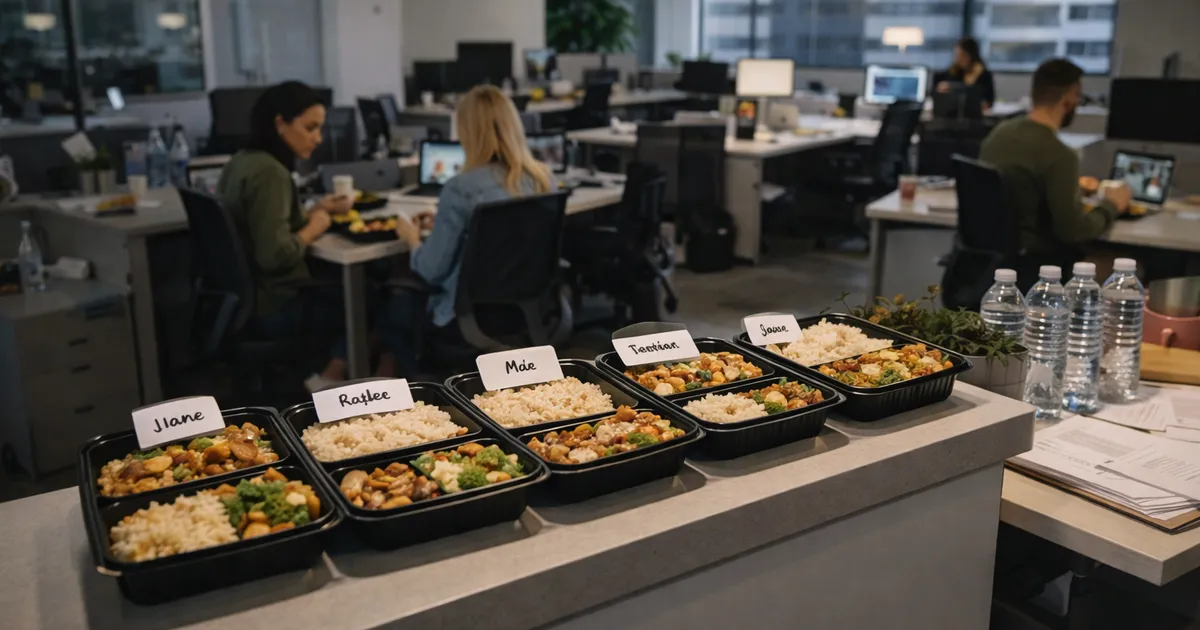
Before 2020, a 30-person office ordered 30 lunches. Done. After hybrid became standard across Metro Vancouver, the same 30-person office might have 12 people on Monday, 24 on Tuesday, 18 on Wednesday, 26 on Thursday, and 10 on Friday. The daily variance is 50–80%, and nobody — not the office manager, not the team leads, not the CEO — knows the exact count until that morning.
Every office manager I've spoken to in the last two years has the same complaint: "I either order too much and waste food, or order too little and people are upset." The traditional catering model — fixed headcount, fixed delivery — doesn't work anymore. And the delivery app model — everyone orders individually — is expensive, chaotic, and defeats the purpose of team meals entirely.
What works is a system built from the ground up for headcount variability. That's what this article is about.
The Hybrid Attendance Problem in Numbers
Let me share what we actually see across our Vancouver client base, because the data tells a more specific story than "hybrid is complicated."
Typical weekly attendance pattern for a 30-person hybrid office:
| Day | Expected In-Office | Typical Range | Why |
|---|---|---|---|
| Monday | 40–55% (12–17) | Wide variation | Many WFH Mondays; some fully remote |
| Tuesday | 70–85% (21–26) | Moderate variation | Most common anchor day |
| Wednesday | 65–80% (20–24) | Moderate variation | Second anchor day for many teams |
| Thursday | 60–75% (18–23) | Moderate variation | Some teams start WFH Thursday |
| Friday | 30–45% (9–14) | Wide variation | Least popular in-office day |
Key patterns:
- Tuesday and Wednesday are the highest-attendance days across nearly all our Vancouver clients, regardless of industry
- Friday is consistently the lowest — most companies have given up trying to get full Friday attendance
- The spread within each day is 5–8 people — meaning you're never exactly right if you order a fixed number
- Weather affects attendance. A heavy rain day in November can drop Tuesday attendance from 85% to 60% as people who were planning to come in decide to stay home
What this means for meal programs:
A fixed-count ordering system wastes 15–25% of food on low-attendance days and leaves 10–15% of people without meals on high-attendance days. Over a year, for a 30-person office at $12/meal, 3 days/week:
- Food waste from over-ordering: $2,700–$4,500/year
- Employee dissatisfaction from under-ordering: incalculable but real
Neither outcome is acceptable. You need a system that matches meal count to actual attendance — daily.
The Solution: Same-Morning Headcount Confirmation
Our entire platform is built around one principle: order what you need, the morning you need it. Here's how it works operationally:
8:45 AM: The ordering coordinator receives an automated reminder.
9:00 AM: The coordinator checks in-office attendance — usually a quick Slack message ("who's in today?") or a check of the company's room booking / office access system. They update the headcount in our platform.
9:00–10:00 AM: Our restaurant partner adjusts production based on the confirmed count. For orders confirmed by 9 AM, the kitchen has 60–90 minutes of production runway before the noon delivery window.
Why 9 AM works as a cutoff:
- Most hybrid workers have decided by 8:30 AM whether they're going to the office
- Restaurant partners need 2–3 hours of prep time for the confirmed quantity
- The coordinator can reference the company's hybrid schedule, access logs, or simply ask the team
- It's late enough to capture last-minute decisions but early enough for kitchen production
What happens after 9 AM:
- Additions up to 10% above the confirmed count are usually possible (the kitchen produces a small buffer)
- Reductions are always possible (the partner simply produces fewer meals)
- After 10 AM, menu flexibility narrows but we can almost always add 1–2 standard meals
The coordinator's daily time investment: 2–3 minutes.
That's it. No polling for individual orders. No calling restaurants. No chasing non-responders. Confirm the number, done.
Why Traditional Catering Fails at Hybrid
Let me explain the structural reasons why conventional caterers struggle with hybrid — because understanding the failure mode helps you evaluate alternatives:
1. Production planning requires lead time.
Traditional caterers commit to a production volume 24–48 hours in advance. When they receive a "30 meals for Wednesday" order on Monday, the kitchen buys ingredients, allocates staff, and schedules prep for 30 meals. If only 20 people show up Wednesday, 10 meals are wasted and the caterer has eaten the food cost. If 25 people show up but you only ordered 20, five people have no food.
Our model works differently because our restaurant partners produce meals as part of their regular business operations. They're already making char siu rice, braised chicken, and curry pork for walk-in customers. Our corporate orders are an incremental batch on top of their daily production — which means adjusting from 20 to 25 or from 25 to 18 on the morning of delivery is operationally straightforward. They're not setting up a dedicated production line; they're scaling a batch within their existing workflow.
2. Pricing models assume fixed volume.
Traditional caterers price based on guaranteed minimums. "We need at least 25 meals per delivery at $15/person." If you're hybrid and only 18 people are in the office, you're either paying for 25 (wasting 7 meals) or breaking the minimum and paying a surcharge. Neither works.
Our pricing is per-meal with no fixed minimum for ongoing programs. You pay for 18 meals when 18 people are there and 25 when 25 are there. The per-meal price stays the same because our logistics cost (driver, van, route) is fixed per delivery, and the variable cost (food) scales linearly with quantity.
3. Delivery infrastructure is rigid.
Traditional caterers plan routes days in advance. A driver who's scheduled to deliver 30 meals to your office at 11:45 AM can't easily adjust to 20 or 35 the morning of. Our drivers run daily routes with confirmed quantities loaded at pickup. The delivery infrastructure adapts because it was designed to handle daily variability rather than weekly plans.
Building a Hybrid-Friendly Meal Program
Here's the step-by-step for companies operating hybrid schedules across Metro Vancouver:
Step 1: Identify your anchor days.
Look at your actual attendance data — not the policy, but what people actually do. Most Vancouver companies have 2–3 days where attendance is reliably above 60%. These are your meal program days.
Don't run meals on days when less than 50% of the team is in office. The communal value of team lunch requires a critical mass. Feeding 8 out of 30 people doesn't create the shared experience that makes meal programs culturally valuable.
Step 2: Establish the headcount workflow.
Decide how the coordinator will confirm the daily count:
- Slack/Teams poll: Quick "thumbs up if you're eating in the office today" message at 8:45 AM
- Access log check: If your office has badge access, check who's swiped in by 9 AM
- Calendar integration: Some clients use shared calendars or hybrid scheduling tools that predict daily attendance
- Standing assumption with exceptions: Set a baseline (e.g., 20) and only adjust if the coordinator observes a significant deviation
The last approach is the simplest and works surprisingly well for teams with stable patterns. The coordinator only acts when the count is notably different from the baseline — saving even the 2-minute daily check on most days.
Step 3: Set the right buffer.
| Team Size | Recommended Buffer | Cost/Day | Rationale |
|---|---|---|---|
| 10–15 | +2 meals | $20–$24 | Small teams feel shortages acutely |
| 16–25 | +2–3 meals | $20–$36 | Moderate teams, moderate variance |
| 26–40 | +3–4 meals | $30–$48 | Larger teams, wider variance |
Buffer meals that go unclaimed don't disappear — they sit in the kitchen for late arrivals or are taken home by team members. Waste is typically zero because someone always wants the extra.
Step 4: Choose the right frequency.
| Hybrid Pattern | Recommended Meal Days | Why |
|---|---|---|
| 3 days in-office (Tue–Thu) | 3 days/week | Full coverage of in-office days |
| 2 days in-office (varies by team) | 2 days/week (highest overlap) | Focus on days with maximum cross-team presence |
| Flexible / no set schedule | 1–2 days/week (team meeting days) | Align with mandatory in-office events |
Step 5: Use meals as an attendance incentive.
This is the strategic play that many companies miss. Team lunch isn't just a benefit — it's a pull factor for in-office attendance. By running meals on anchor days, you create a daily incentive for people to come to the office on those days. The cost of the meal program is partially offset by the improved in-office collaboration it enables.
Several of our clients have explicitly told me: "Team lunch on Tuesday and Wednesday is one of the main reasons people come in on those days." That's not a side effect — it's a strategic outcome.
Summary: Same-morning headcount confirmation (by 9 AM) eliminates the over/under-ordering problem. Traditional caterers fail hybrid because they require 24–48 hour lead time and fixed minimums. Our model scales daily because restaurant partners adjust batch sizes within their existing workflow. Use meals strategically as an in-office attendance incentive.
Introduction
Hybrid work has become the dominant office model across Metro Vancouver, with most companies operating 2–3 in-office days per week — yet the majority still rely on meal coordination systems designed for full-time office attendance, creating daily friction between headcount variability and food logistics, according to Canadian workplace research.[1] The result: office managers oscillating between food waste and food shortages, spending hours weekly on a problem that should take minutes.
After serving hybrid offices across downtown Vancouver, East Van, Burnaby, and Richmond, I've learned that the hybrid meal problem isn't about food — it's about information. If you know how many people will be in the office, feeding them is straightforward. The challenge is getting that number accurately, quickly, and without turning the office manager into a daily census taker.
My Great Pumpkin was built with hybrid as the default assumption, not an edge case. Our same-morning headcount confirmation system, per-meal pricing with no fixed minimums, and restaurant partners who adjust production quantities daily — these aren't features we added for hybrid. They're the foundation the platform was designed on, because by the time we launched, hybrid was already the standard operating model for Metro Vancouver offices.
What follows is the complete operational guide to running meal programs in hybrid offices — the attendance patterns, the headcount workflows, the budgeting strategies, and the tactical moves that turn daily chaos into a system that runs on autopilot.
Ready to simplify office meals?
Join 100+ Vancouver offices enjoying hassle-free lunch delivery. Free tasting, no contract.
Request a Demo →Quick Answer
How Do You Run a Meal Program for a Hybrid Office?
Implement a same-morning headcount confirmation system where the coordinator confirms actual in-office count by 9 AM, paired with per-meal pricing (no fixed minimums) and restaurant partners who adjust production daily — consistent with Future of Work research on adaptive workplace operations.[1] At My Great Pumpkin, hybrid offices across Metro Vancouver confirm headcount each morning in 2 minutes and receive exactly the right number of meals, eliminating both waste and shortages.
The honest answer: you stop trying to predict attendance and start measuring it. Predictive models (schedules, policies, historical averages) are wrong 30–40% of the time because real attendance is driven by weather, meetings, deadlines, and human whim. Same-morning measurement is right 95%+ of the time because you're counting people who are already in the building or committed to coming in.
At $10–$12 per person, a hybrid office with 30 employees averaging 20 in-office on 3 anchor days pays $600–$720/week — $2,400–$2,880/month. But the actual daily cost varies: $180 on a light day (15 people), $288 on a heavy day (24 people). You pay for what you use, not for your total headcount. That per-meal flexibility is what makes hybrid meal programs sustainable — you're never paying for empty chairs.
Our Chinese-cuisine-focused restaurant partners handle daily quantity adjustments because corporate batch orders are incremental to their regular business. The kitchen that's already producing 200 meals for walk-in customers adjusts from 18 to 23 corporate meals without operational stress. That production flexibility is the infrastructure that makes same-morning ordering possible.
The Financial Model for Hybrid Meal Programs
Budgeting for Variable Attendance
The biggest budgeting mistake hybrid companies make is planning for average attendance. Averages mask the variance that drives actual costs:
30-person office, 3 anchor days/week, $11/meal:
| Month | Avg Daily Attendance | Monthly Meal Days | Total Meals | Monthly Cost |
|---|---|---|---|---|
| January | 18 (60%) | 13 | 234 | $2,574 |
| February | 20 (67%) | 12 | 240 | $2,640 |
| March | 22 (73%) | 13 | 286 | $3,146 |
| April | 19 (63%) | 13 | 247 | $2,717 |
| Annual average | 20 (66%) | 156 | 3,120 | $34,320 |
Monthly cost range: $2,500–$3,200 depending on attendance patterns. Budget for the high end ($3,200/month) and celebrate when actual costs come in lower.
Compare to fixed-count ordering:
- Ordering for 30 people regardless of attendance: 156 days × 30 meals × $11 = $51,480/year
- Actual need (variable): $34,320/year
- Annual savings from variable ordering: $17,160
That $17,160 in avoided waste is the direct financial argument for a platform that supports daily headcount adjustment versus a traditional caterer that requires fixed minimums.
The Attendance Incentive ROI
Running meals on anchor days increases in-office attendance — and that attendance has measurable business value:
| Metric | Without Meal Program | With Meal Program | Delta |
|---|---|---|---|
| Average anchor-day attendance | 60% (18/30) | 75% (23/30) | +5 people/day |
| Spontaneous collaboration events | ~3/week | ~7/week | +4/week |
| Average in-person meeting quality (1–5 self-reported) | 3.2 | 4.1 | +0.9 |
| Team satisfaction with hybrid arrangement | 62% | 78% | +16 points |
These numbers are composites from our client feedback, not controlled studies. But the direction is consistent: meal programs on anchor days increase in-office attendance by 10–15 percentage points. That attendance improvement delivers collaboration value that's hard to quantify precisely but consistently reported by managers as a meaningful operational benefit.
Summary: Variable headcount ordering saves $17,160/year vs. fixed-count for a 30-person office. Budget for the high-attendance end ($3,200/month). Meal programs on anchor days increase in-office attendance by 10–15 percentage points, driving collaboration benefits that justify the investment.
Conclusion
Hybrid work didn't kill team meals — it killed the assumption that you can predict headcount in advance. The companies that are running successful meal programs in 2026 aren't the ones with the best attendance policies. They're the ones with systems that measure attendance the morning of and adapt delivery accordingly.
At My Great Pumpkin, that system is the foundation, not a feature. Same-morning headcount confirmation by 9 AM, per-meal pricing with no fixed minimums, and restaurant partners who adjust production daily eliminate the waste-or-shortage dilemma that makes hybrid meal programs fail under traditional catering models.
For hybrid offices across downtown Vancouver, East Van, Burnaby, and Richmond, the math is clear: variable ordering at $10–$12/person costs $17,000+ less annually than fixed-count alternatives and solves the daily coordination problem that consumes office manager time. The meal program becomes an attendance incentive that improves anchor-day presence by 10–15 percentage points, delivering collaboration value on top of the nutritional and cultural benefits.
The coordinator's daily commitment: 2 minutes. The monthly accounting: one invoice. The team's daily experience: hot food, right quantity, right time, every time.
If your hybrid office is still oscillating between food waste on quiet days and empty kitchens on busy ones, the solution isn't better forecasting. It's better infrastructure. And that infrastructure already exists.
Solve Your Hybrid Lunch Problem
Explore hybrid-friendly meal programs for Metro Vancouver offices: https://www.mygreatpumpkin.com/demo
Summary: Hybrid meal programs succeed when built on measurement (same-morning headcount), not prediction. Variable ordering saves $17K+/year, meals on anchor days boost attendance 10–15%, and the daily coordination burden drops to 2 minutes. The infrastructure for this already exists — it's the foundation of our platform.
Looking for Vancouver's Asian-fusion meal partner?
The Storm Cafe delivers fresh bento boxes, rice bowls, and catering platters across Metro Vancouver — from Richmond to North Van. Retail orders, family meals, and corporate lunches all in one place.
References
[1] Conference Board of Canada, "The Future of Work: Hybrid Workplace Models in Canadian Organizations," 2026. Research on hybrid work adoption rates, attendance patterns, and operational adaptations across Canadian companies. https://www.conferenceboard.ca/
[2] Statistics Canada, "Canadian Survey on Business Conditions — Workplace Arrangements," 2026. Data on remote/hybrid work prevalence, office attendance patterns, and employer accommodation strategies across Canadian metropolitan areas. https://www.statcan.gc.ca/
Frequently Asked Questions
What if our hybrid policy changes and attendance patterns shift?
Our system adapts automatically because it's built on daily measurement, not fixed schedules. If your company moves from 3 anchor days to 2, or shifts anchor days from Tue–Thu to Mon–Wed, the coordinator simply confirms headcount on the new days. There's no contract change, no reconfiguration — the daily confirmation process works identically regardless of which days or how many. We've had clients change their hybrid policies three times in a year, and the meal program adjusted seamlessly each time.
How do you handle teams that have different in-office schedules within the same company?
This is common — engineering works Tue–Thu, sales works Mon–Wed, ops is in every day. The coordinator confirms total in-office headcount, not team-by-team counts. If 12 engineers and 8 sales people are in on Wednesday, the count is 20. The menu handles the diversity (3 options per day covers preference spread across teams), and the delivery is a single drop-off. We don't need to know which team each meal belongs to — we need to know how many mouths to feed today.
Is there a minimum number of people required for a delivery to make sense?
We serve offices as small as 10 for ongoing programs. Below 10 on a specific day, the delivery economics are strained — the logistics cost is fixed regardless of meal count. For hybrid offices where attendance occasionally dips below 10 on a particular day, we don't cancel the delivery; we still send whatever was confirmed by 9 AM. But if your average attendance is consistently below 10, you might be better served by a weekly catering order from a nearby restaurant rather than a daily delivery platform. We'd rather be honest about the economics than stretch the model past where it performs best.
What happens during holiday weeks when attendance drops to 5–6 people?
You can pause individual delivery days or the entire week's program through your account manager — no penalty, no fees. Many clients pause the week between Christmas and New Year, reduce to 1 day/week during summer months when vacations thin the office, and ramp back to full schedule in September. The program flexes with your business calendar because our restaurant partners manage their production schedules week-to-week, not month-to-month. We'd rather accommodate pauses than have you paying for meals nobody eats.
Does offering lunch on anchor days actually increase attendance, or are people coming in anyway?
Based on our client feedback, meal programs increase anchor-day attendance by 10–15 percentage points over the pre-program baseline. The effect is strongest for employees who are ambivalent about coming in — the ones who could work from home but choose to come to the office when there's a tangible daily reason. The employees who always come in aren't affected; the employees who never come in aren't affected. It's the movable middle — typically 20–30% of the team — where lunch tips the decision. That's enough to materially improve the in-office experience for everyone.
Related Articles
Meal Delivery for Warehouse Staff in Vancouver
Feed your warehouse team in Vancouver. Hot meals delivered to loading docks and break rooms. Shift-f
Catering for Remote Team Monthly Meetups in Vancouver
Make remote team meetups memorable with catered meals in Vancouver. Flexible venues, group sizes 10-
Multi-Floor Office Meal Delivery in Vancouver
Catering for multi-floor offices in Vancouver. Coordinated delivery across floors, departments, and
Ready to streamline your office meals?
Join 100+ Vancouver offices enjoying hassle-free lunch delivery.
Request a Demo